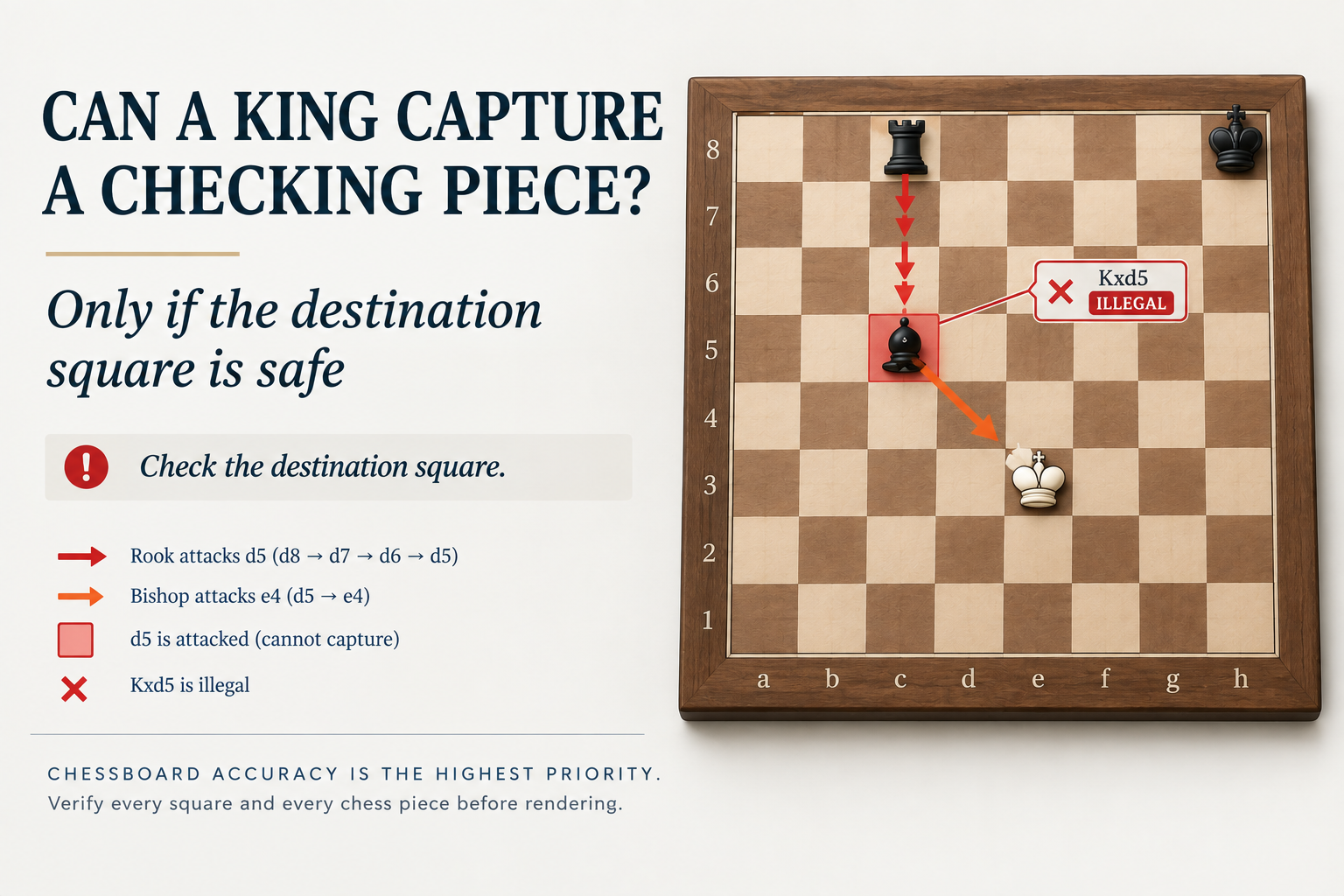
Can a King Capture a Checking Piece?
Sometimes yes, sometimes it’s completely illegal — and the difference comes down to one thing: what happens to your king on the square it would land on, not which piece is being captured.
Take a white king on e4 with a black bishop on d5, and nothing else attacking d5. The bishop is close enough to capture, and if Kxd5 leaves the king somewhere no black piece attacks, the capture is legal — the check disappears along with the bishop. Now add a black rook defending that same bishop. Suddenly Kxd5 is illegal, because after the capture the king would be standing on d5, a square the rook still attacks. The bishop’s gone, but the king is still in check — and a king can never end its own move in check.
That’s the idea worth generalizing: look at the destination square, not just the piece sitting on it. This applies everywhere the king moves — capturing a checking piece, capturing anything else, or simply stepping out of check.
There’s a sharper version of this worth knowing too. Say a black knight gives check while a black rook protects it from a distance. Even though the rook itself might be pinned or otherwise unable to move, FIDE’s Laws still count it as attacking that square — a piece doesn’t stop “attacking” just because moving it would expose its own king. So a protecting piece that looks stuck can still make the king’s capture illegal.
Double check makes this even more restrictive. If two enemy pieces are giving check at the same time, the king can’t solve the problem by capturing either one — removing one attacker still leaves the other in place, and the king would still be in check right after its own move. That’s actually the one situation where capturing is never legal, no matter how exposed either checking piece looks; moving the king to safety is the only response left.
None of this restricts other pieces the same way. If a piece other than the king can capture the checking piece without leaving the king in check, that’s a perfectly legal response — the “don’t land on an attacked square” rule is specific to the king, since only the king can never remain in check after its own move.
FIDE Article 3.9.2 states that no move may leave or place a player’s own king under attack, and Article 3.1.3 explains how a piece is considered to attack a square — including the case above. (FIDE Laws of Chess)
Leave a Reply