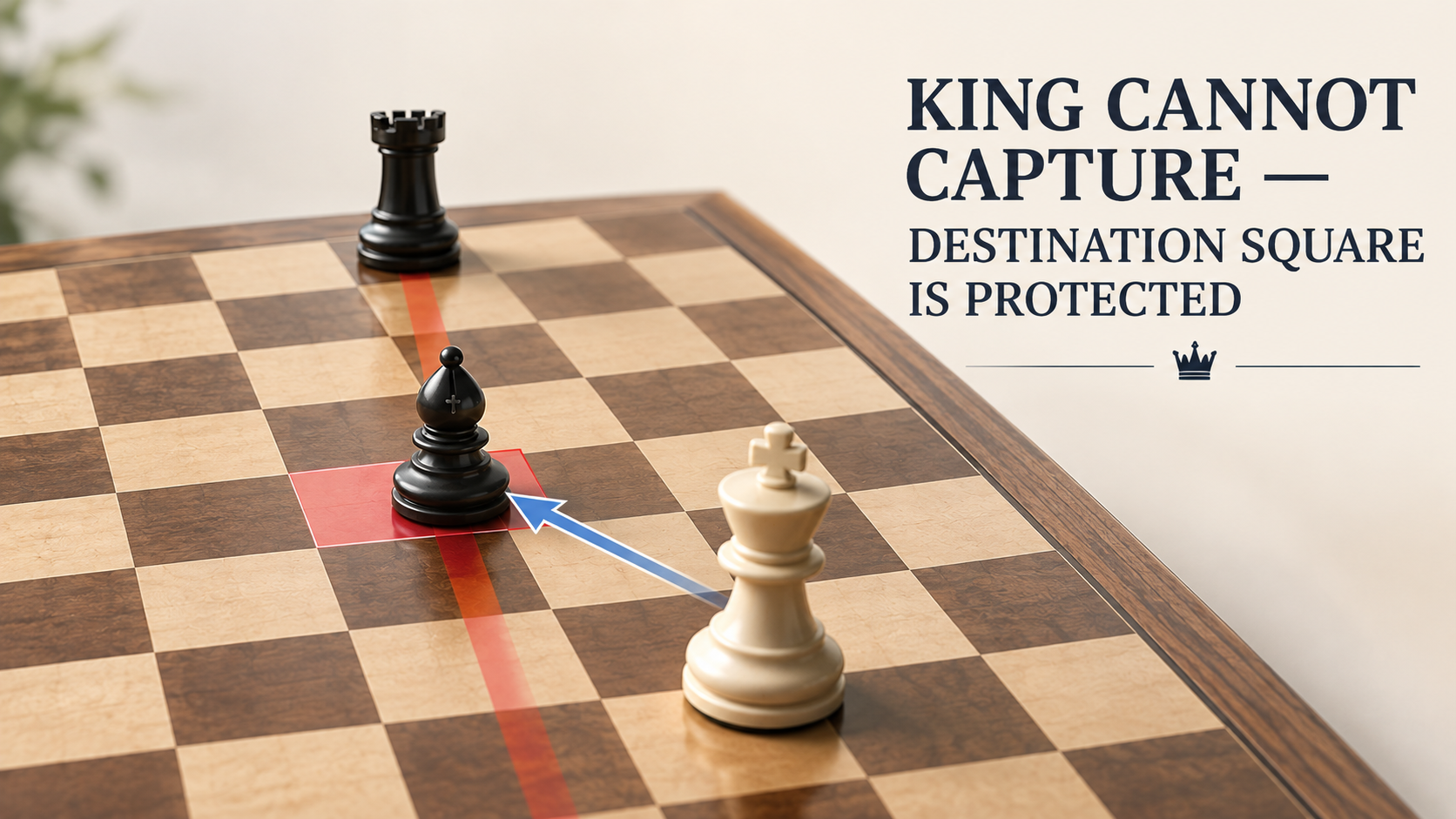
Imagine White’s king is right next to a black bishop, looking like an easy capture — except another black piece is defending it. No — a king can’t capture an opposing piece if the square that piece occupies is protected by another enemy piece, because after the capture the king would be sitting on a square under attack, which is never legal.
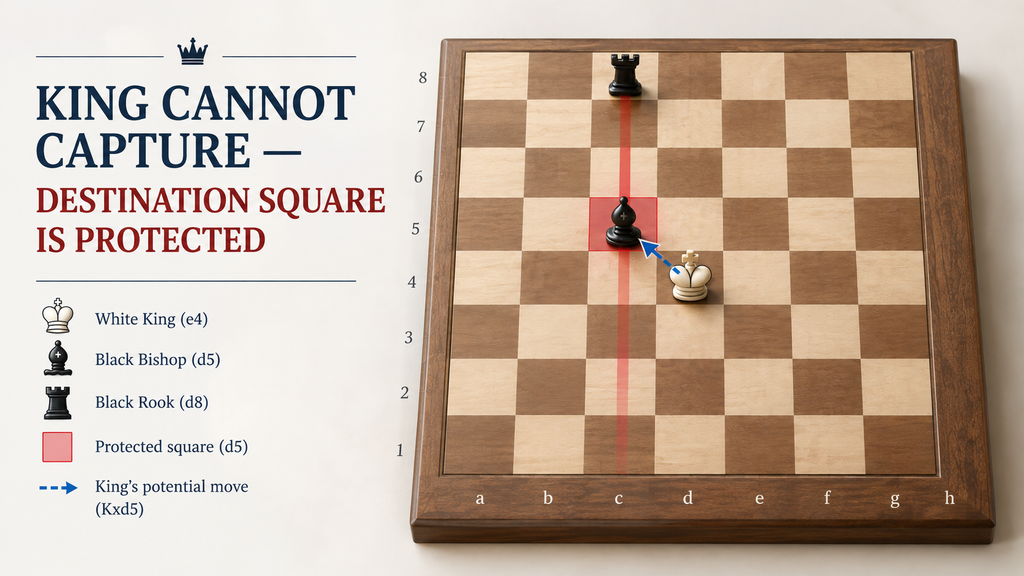
Look at the Square the King Would Capture On Suppose White’s king is on d4 and a black bishop sits on c5. At first glance it looks free — “the bishop’s right next to my king, so I can just take it.” But before making that capture, White has to check the square c5 itself. If another black piece attacks c5, the king can’t capture the bishop at all. The real question isn’t whether the piece can theoretically be captured — it’s whether the king would actually be safe standing on that square afterward.
Here’s the Key Difference A king is generally allowed to capture an opposing piece, but it’s never allowed to capture onto a square that’s under attack. Say the black bishop on c5 is defended by a black rook — White can’t play Kxc5, because after the capture the white king would be sitting on a square the rook attacks. The bishop gets captured, but the king would still effectively be in check on its new square — which makes the move illegal.
What If the Protecting Piece Cannot Actually Move? This is where things get genuinely confusing. A player might notice the protecting piece is pinned, and technically unable to move because doing so would expose its own king. But under the FIDE Laws, a piece is still considered to attack a square even when it’s constrained from moving there because that move would leave or place its own king under attack. So you can’t assume a pinned piece makes a square safe just because that piece itself can’t legally move — the king still has to treat that square as covered.
What If the Piece Is Not Protected? Now flip the situation. White’s king is on d4, and a black bishop sits on c5 — but this time nothing defends it. White may be able to capture it outright, as long as the rest of the position doesn’t otherwise prevent the capture. If no black piece attacks c5, the capture may well be legal.
A Quick Way to Check Whenever your king wants to capture something, don’t stop at “can my king reach that square?” Ask instead “is that square attacked once my king gets there?” Check every opposing piece that could potentially attack the destination square — if it’s attacked, the king can’t capture there; if it’s genuinely clear, the capture may be legal.
Why This Matters in Check This becomes especially important when a king is trying to escape check in the first place. Sometimes the checking piece looks capturable simply because it’s sitting right next to the king — but if another enemy piece protects it, the king can’t take it, and has to find a different way out entirely.
The FIDE Laws explain that a piece attacks a square if it could capture on that square according to its normal rules of movement — and specifically preserve that “attacks the square” status even when a piece is constrained from actually moving there because doing so would expose its own king. This is covered under Article 3.1.3 of the FIDE Laws of Chess. Remember: a king can capture an opposing piece only when the destination square is genuinely safe — if another enemy piece protects that square, the capture is off the table. Official FIDE Laws of Chess.
Leave a Reply