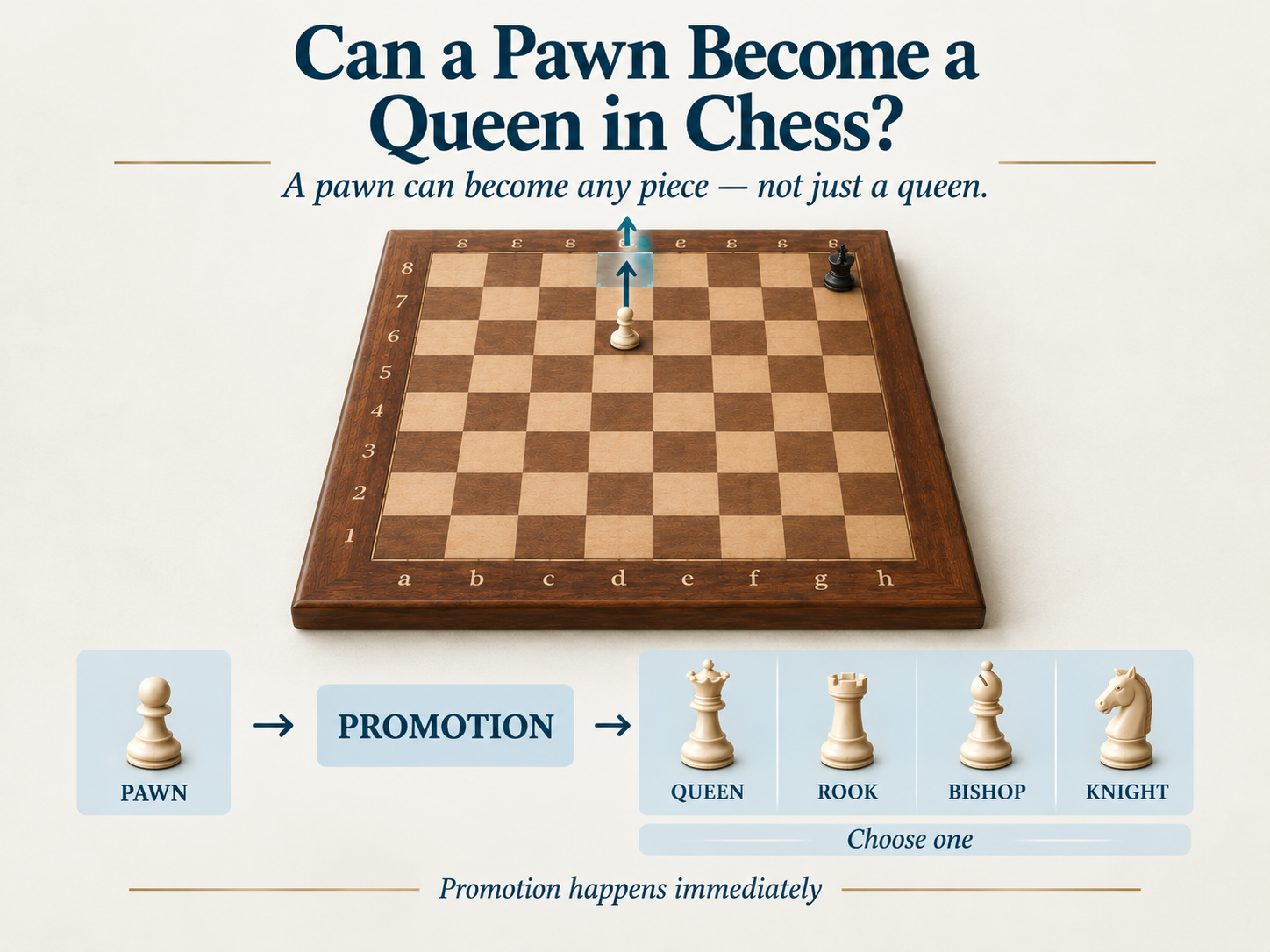
Can a pawn become a queen? Yes.
Yes — though a queen isn’t actually the only option, and that’s the part people usually get wrong first. When a pawn reaches the far side of the board, it must be exchanged for a new piece as part of that same move, and the player gets to choose which one: queen, rook, bishop, or knight, all of the same colour.
A Common Misunderstanding It’s easy to assume reaching the other side of the board automatically turns a pawn into a queen. That’s not quite right — the pawn must be exchanged, and the player chooses among the four eligible pieces as part of the promotion move itself.
When Does Promotion Happen? A pawn promotes the moment it reaches the furthest rank from its starting position — the eighth rank for White, the first for Black. A white pawn moving from e7 to e8, for instance, cannot simply sit there as a pawn; it has to be exchanged right then. The same is true for a black pawn reaching e2 to e1.
Does the Pawn Have to Become a Queen? No. The player can choose any of the four permitted pieces — e8=Q, e8=R, e8=B, or e8=N, whichever the position calls for. The choice belongs entirely to the player making the promotion.
Why Would Anyone Choose a Knight? A queen is usually the strongest promotion choice, but there are positions where a knight actually serves better. This is called underpromotion. A knight moves in ways a queen simply can’t, so promoting to one can sometimes create an immediate tactical opportunity — a knight promotion might deliver check in a situation where a queen promotion wouldn’t. The same logic occasionally applies to choosing a rook or bishop instead.
Can You Have Two Queens? Yes — you aren’t limited to the queen you started the game with. If a pawn promotes to a queen while your original queen is still on the board, you end up with two queens, and technically even more if multiple pawns promote in the same game. The FIDE Laws specifically state that the player’s choice isn’t restricted to pieces that have previously been captured.
What If the Promotion Square Is Occupied? A pawn can also reach the final rank by capturing rather than pushing straight ahead. A white pawn on e7, for example, could capture a black piece sitting on f8 and promote right there — the captured piece is removed, and the pawn is exchanged for whichever piece the player chooses.
Does the New Piece Take Effect Immediately? Yes. Once the pawn is promoted, the new piece has its full normal movement and abilities right away — it doesn’t wait until the next turn. Promote to a knight, and that knight functions as a knight from that instant.
When your pawn reaches the opposite end of the board, it must promote, and you choose among queen, rook, bishop, or knight — even if you already have one of that piece on the board.
FIDE Articles 3.7.3.3 through 3.7.3.5 cover promotion in full: it’s mandatory upon reaching the furthest rank, the choice isn’t limited to previously captured pieces, and the new piece’s effect is immediate. Official source: FIDE Laws of Chess.
Leave a Reply