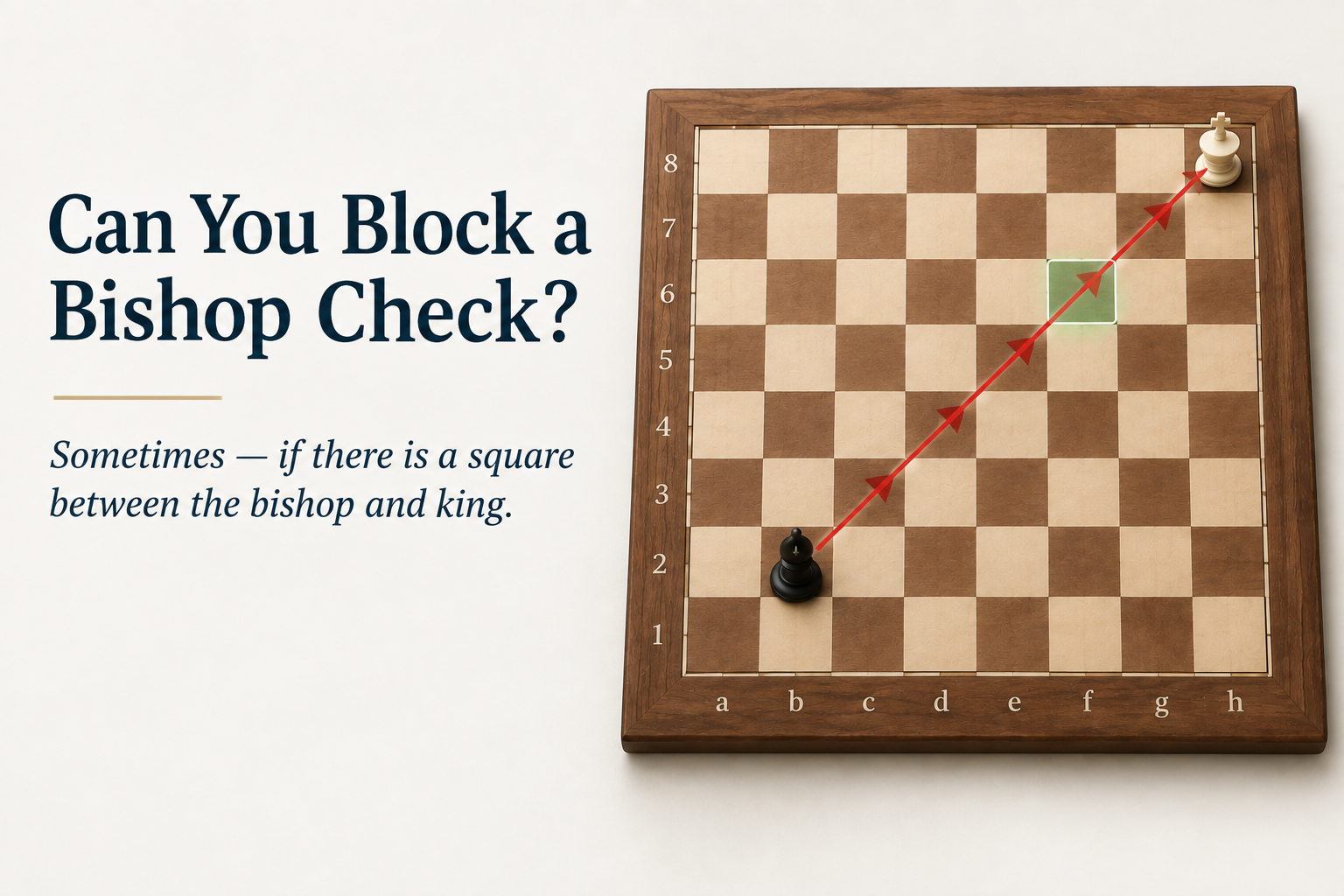
Can you block a bishop check?
Whether a bishop check can be blocked comes down to one simple question: is there any square between the bishop and the king? A bishop attacks along diagonals, sliding as far as the board and other pieces allow, so if there’s room on that diagonal, another piece can sometimes step into it and cut the attack off before it reaches the king.
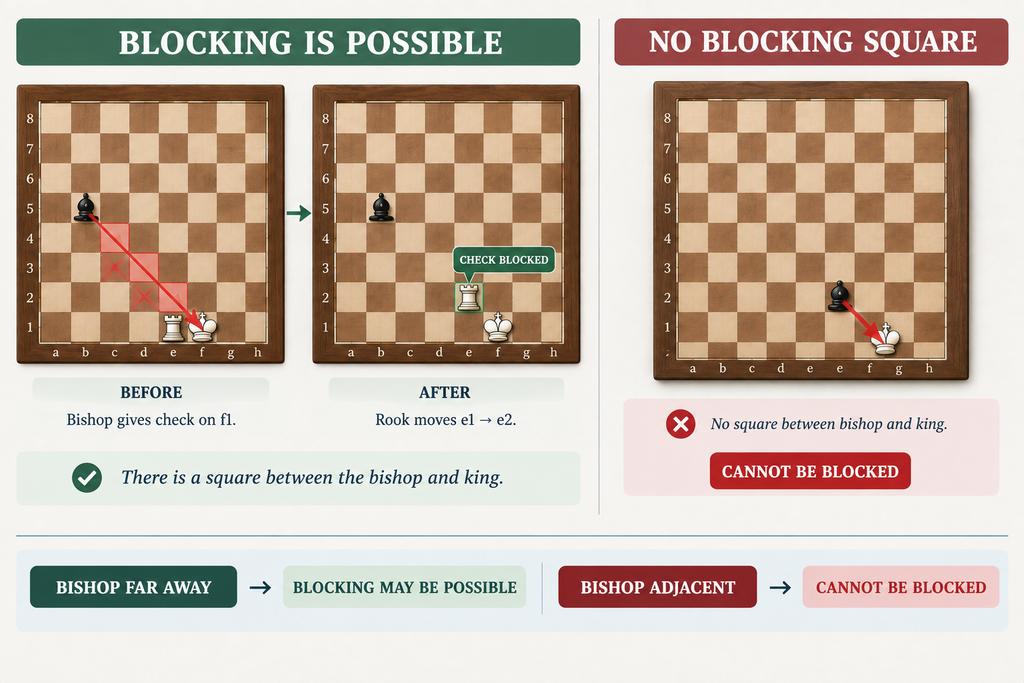
Take a bishop on b5 aiming at a king on f1, along the diagonal b5–c4–d3–e2–f1. That’s a long diagonal with three empty squares in between — c4, d3, and e2 — any one of which could, in principle, host a blocking piece, as long as something can legally reach it and the resulting position actually leaves the king safe. If White drops a piece onto d3, say, the bishop’s line to f1 is cut, and the check is gone.
Move the same bishop to e2 instead, directly next to the king, and the picture changes completely. There’s no square left between e2 and f1 — the bishop is now attacking adjacently, the same way a knight or pawn would, and there’s nothing to block. The only options left are moving the king or capturing the bishop outright.
That’s the entire distinction: distance matters, adjacency doesn’t allow it. The same logic governs rooks and queens whenever they check along an open line — if there’s room between the piece and the king, blocking is on the table; if the checking piece is right next to the king, it isn’t, regardless of what kind of line-moving piece is doing the checking.
It’s worth being careful about what actually counts as a legal block, though, because finding an empty square on the diagonal isn’t automatically enough. Say a black rook sits somewhere that would attack the white king the instant a particular white piece moves off its current square — a pin, in other words. If that same piece is the only one that could reach the blocking square on the bishop’s diagonal, moving it there to block the bishop might simultaneously expose the king to the rook’s attack from a completely different direction, which makes the block illegal despite technically closing the bishop’s line. The test is never just “does this stop the bishop” — it’s “does my king end up safe once the dust settles,” exactly as with any other response to check.
FIDE Article 3.5 covers how a bishop moves along diagonals, while Articles 3.9.1 and 3.9.2 define check and require that no move leave the mover’s own king under attack. (FIDE Laws of Chess)
Leave a Reply