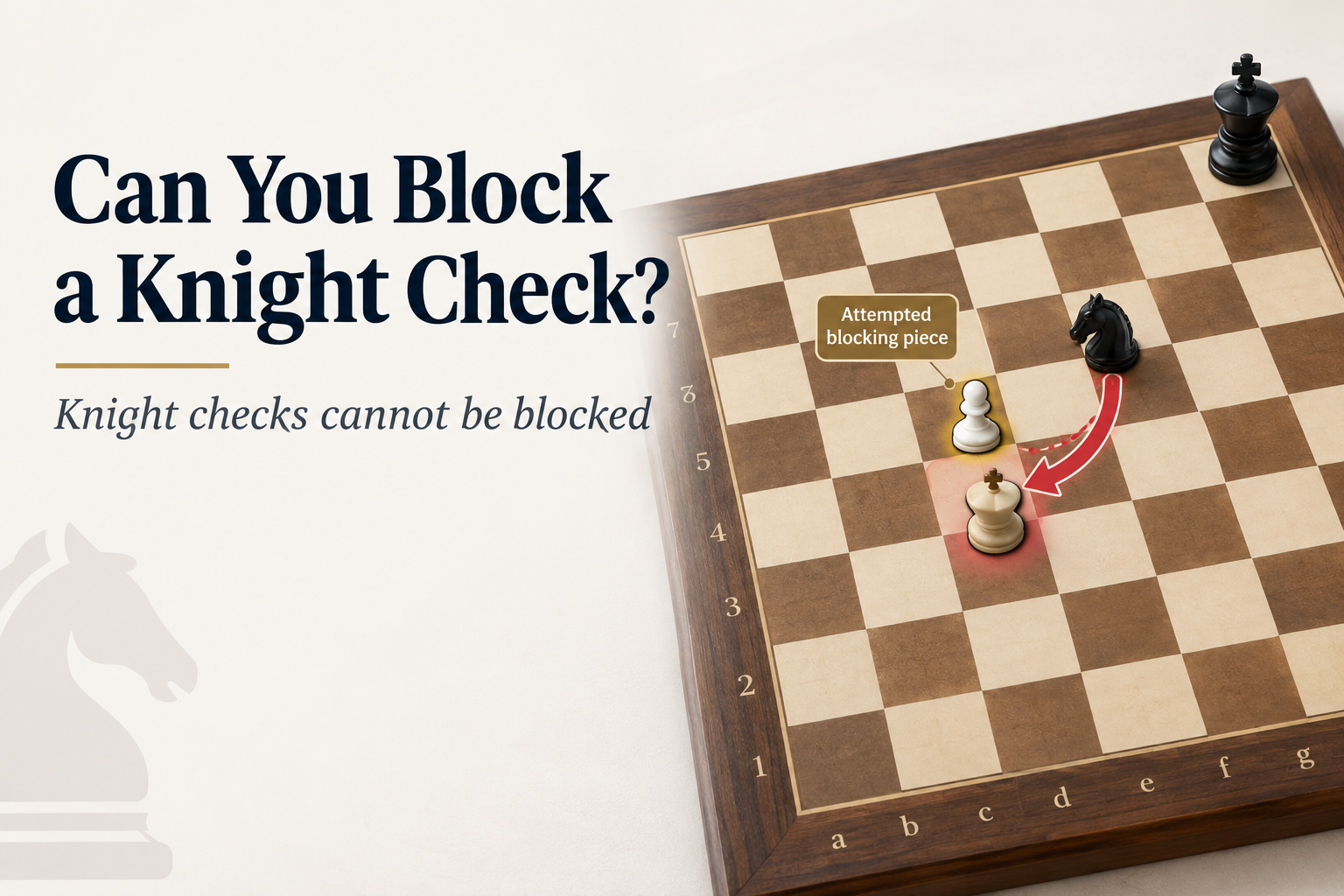
Can you block a knight check? No.
Unlike a rook, bishop, or queen, a knight’s attack can’t be stopped by placing a piece between the knight and the king — because knights don’t attack along a line at all. They jump directly to their destination square.
The Instinct to Block Doesn’t Apply Here It might seem logical that if a piece is giving check, you can simply put another piece in between. That works against some checks — if a rook is checking your king along a file, you may genuinely be able to place a piece between the rook and the king. But a knight works completely differently: a knight moves to one of the nearest squares that isn’t on the same rank, file, or diagonal, in its familiar L-shape — two squares in one direction, then one square perpendicular. Because the knight jumps straight to its destination, placing another piece somewhere in between accomplishes nothing at all. The knight simply attacks the king from its own square, regardless of what’s sitting in the supposed “gap.”
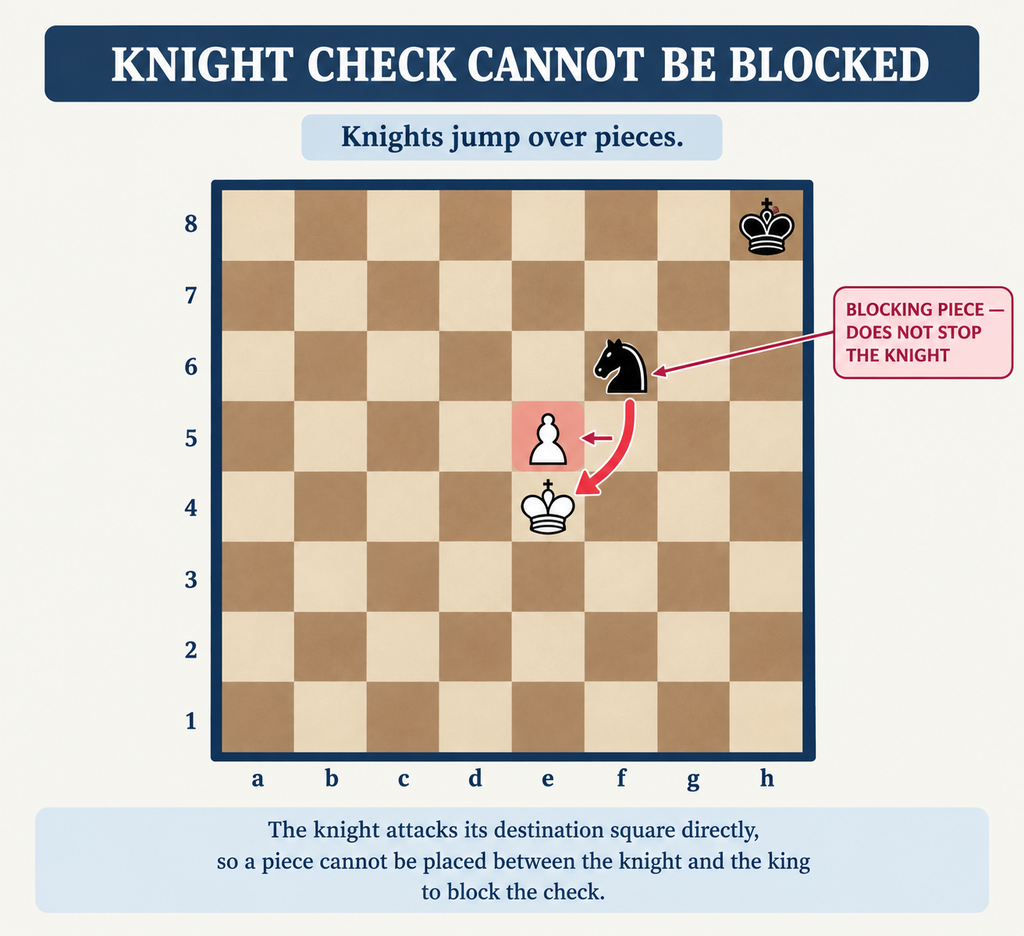
So How Do You Escape a Knight Check? If a knight is checking your king, you still have legal ways to respond. First, move the king to a square where it’s no longer attacked — the destination has to be genuinely safe. Second, capture the knight, either with your king (if the knight’s square is itself safe) or with another piece entirely. A bishop, rook, queen, knight, or pawn may all be capable of capturing the checking knight, depending on the position — the important question is always whether your king ends up safe after the capture.
What You Cannot Do You cannot respond to a knight check by placing a piece between the knight and your king. Imagine a black knight checking a white king — even placing a white piece somewhere in the supposed gap changes nothing; the knight’s attack remains exactly as it was. The only useful responses are ones that genuinely remove the check.
Why This Matters Knowing whether a check can even be blocked helps you find your legal moves faster during an actual game. When a rook, bishop, or queen gives a line check, it’s worth looking for a possible blocking square. When a knight gives check, don’t waste time searching for a square between it and your king — go straight to “can I move my king?” and “can I capture the knight?” instead.
What About Other Pieces? The same underlying idea applies elsewhere on the board. A knight can’t be blocked because it jumps directly to its target. A rook, bishop, or queen can sometimes be blocked because their attacks travel along ranks, files, or diagonals with actual space in between. But even with those pieces, blocking is only legal if the move genuinely removes the check — finding a square in the way isn’t automatically enough on its own.
Knight check means no blocking, full stop. When a knight attacks your king, don’t look for a piece to put in the way — look instead for a way to move the king or capture the knight, while making sure your king isn’t left under attack in the process.
FIDE Article 3.6 describes how the knight moves: to one of the nearest squares that isn’t on the same rank, file, or diagonal. Articles 3.9.1 and 3.9.2 define check and require that a move never leave your own king in check. Official FIDE source: FIDE Laws of Chess.
Leave a Reply