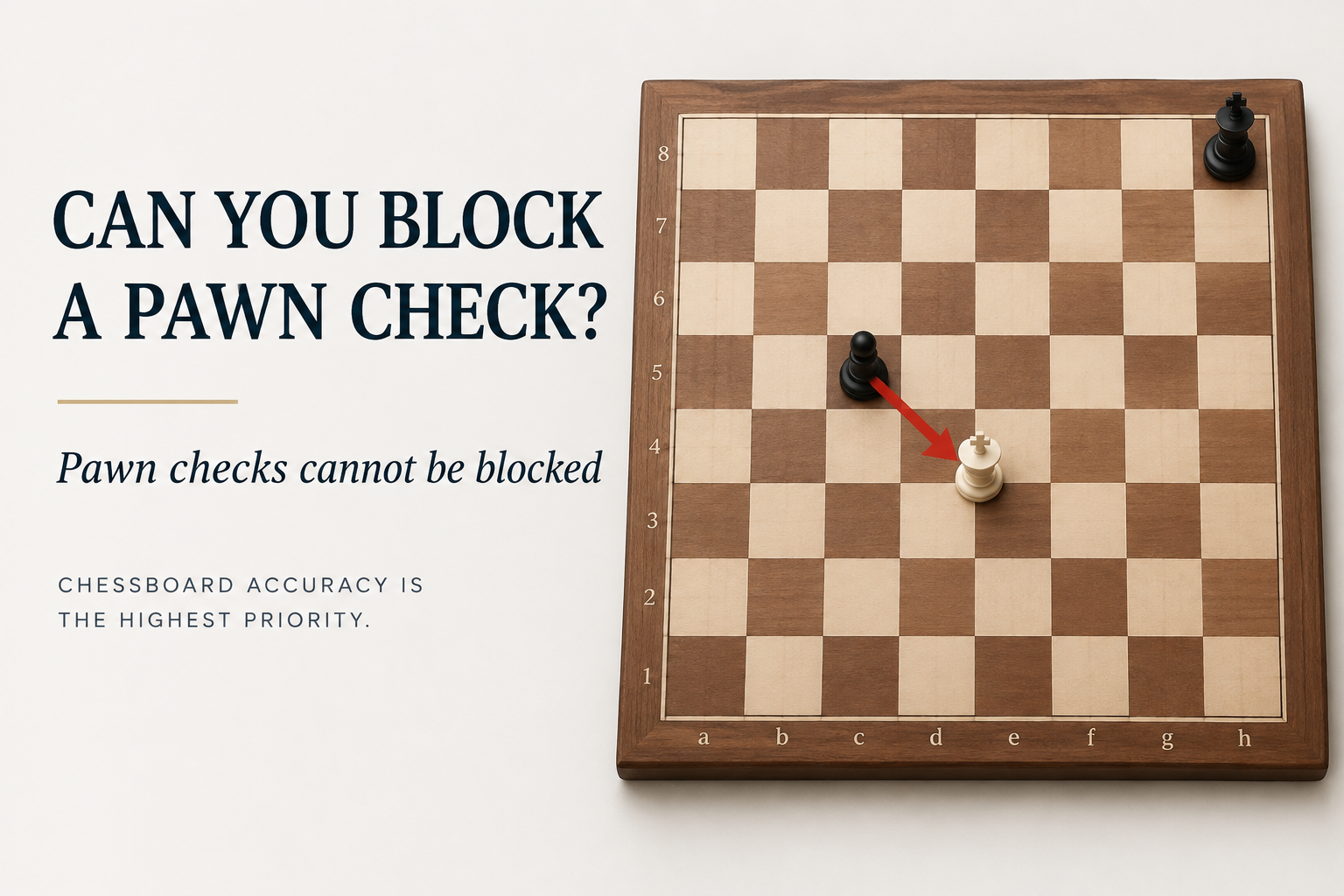
Can you block a pawn check?
A pawn attacks the way no other piece does — forward-moving but diagonal-striking — and that mismatch is exactly what makes a pawn check impossible to block. There’s no line between a checking pawn and your king that another piece could ever step into, because the pawn was never attacking along a line in the first place. It just hits its target square directly, the same way a knight does.
Take a white king on e4 with a black pawn landing on d5. That pawn attacks c4 and e4 — the two squares diagonally in front of it — so the king is in check the instant the pawn arrives, even though the pawn itself is sitting one square away and one file over. There’s simply nothing between d5 and e4 to occupy; the attack isn’t traveling through empty space the way a rook’s or bishop’s would.
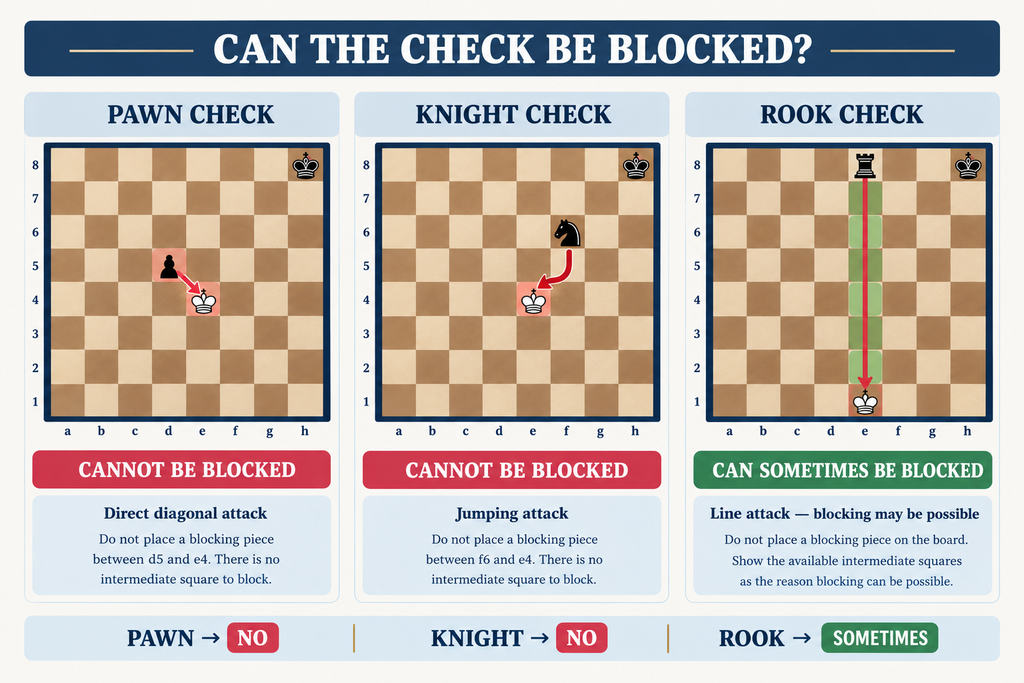
That’s the detail that separates pawn (and knight) checks from checks by a rook, bishop, or queen. Those three pieces slide along a rank, file, or diagonal, so if there’s distance between them and the king, a piece can sometimes step into that gap and interrupt the line. A pawn has no “in between” — it attacks its target square the moment it’s adjacent to it diagonally, full stop.
So when a pawn gives check, the options narrow to two: move the king somewhere safe, or capture the pawn — with your king if the destination is safe, or with another piece if one can legally reach it. Say a second white pawn sits on c2 or e2; either one could potentially capture the checking pawn on d5 outright and end the check that way, provided nothing else on the board makes that capture illegal.
There’s an edge case worth flagging, because it’s the same trap that shows up with any checking piece: a pawn that looks freely capturable might actually be defended. If a black knight sits somewhere it protects d5, then a white king capturing that pawn would land on a square the knight still attacks — an illegal move, since the king would still be in check right after its own turn. The pawn being small and seemingly disposable doesn’t exempt it from the same defended-square check that applies to every other capture.
It’s also worth remembering the forward-versus-diagonal split doesn’t just matter for identifying the check — it explains why a pawn can never check the square directly ahead of it, only the two squares diagonally in front. A pawn sitting one square in front of your king, blocking its path, isn’t giving check at all; it’s simply in the way.
FIDE Article 3.7.3 sets out how a pawn captures — diagonally onto an adjacent file — while Articles 3.9.1 and 3.9.2 define check and require that no move leave the mover’s own king under attack. (FIDE Laws of Chess)
Leave a Reply