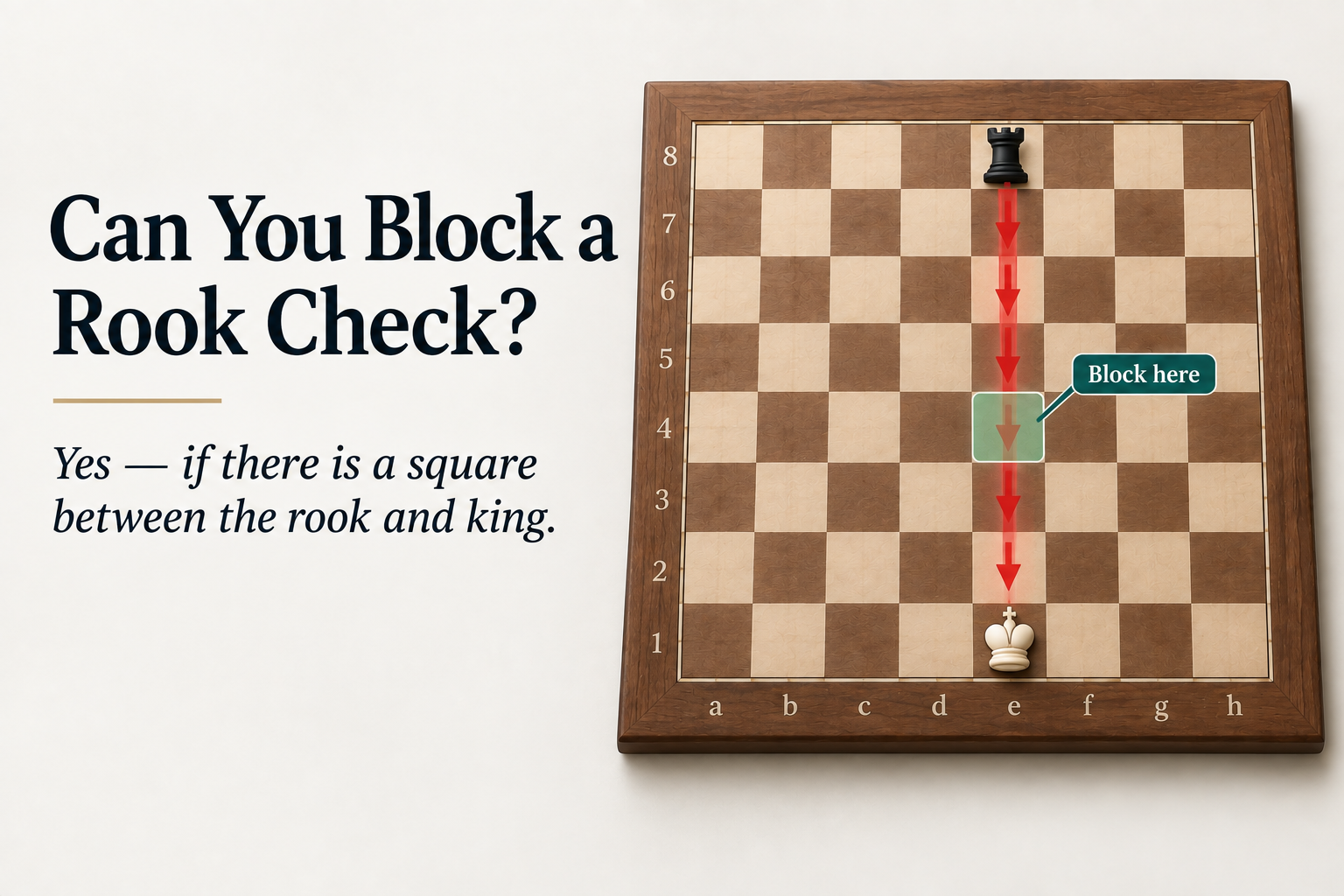
Can you block a rook check?
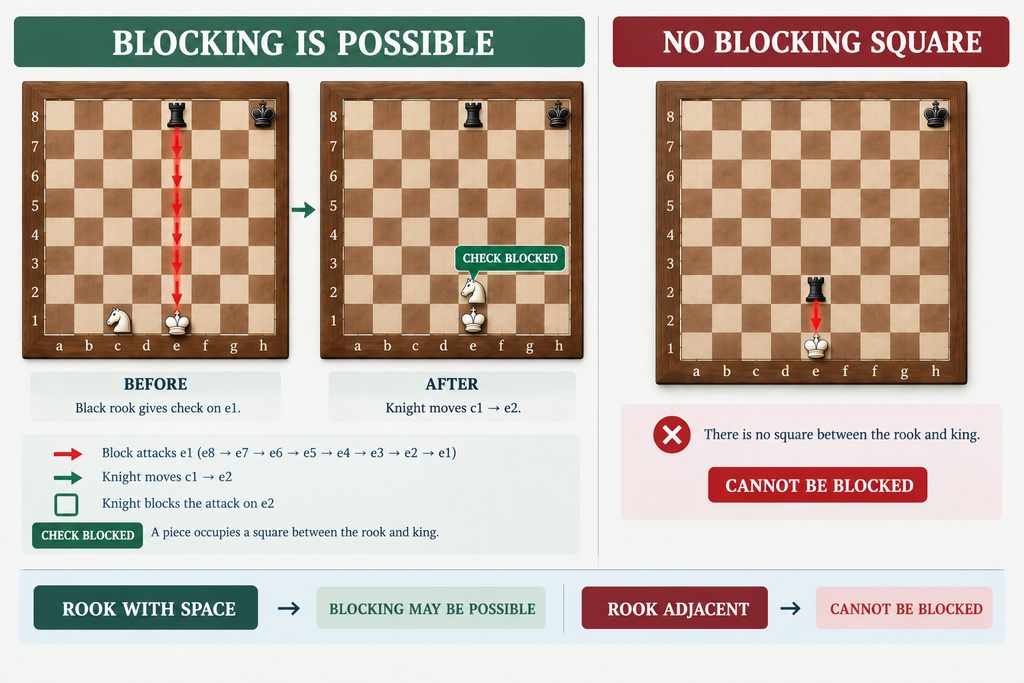
Yes, sometimes — and it comes down to the same question that decides every sliding-piece check: is there a square between the attacker and your king?
A rook attacks along ranks and files, sliding as far as the board allows, so if your king sits somewhere along that same open line, there’s room to work with. Take a king on e1 with a black rook on e8, and nothing standing between them on the e-file. That’s six empty squares — e2 through e7 — any one of which could, in principle, hold a blocking piece, as long as something can legally reach it and your king ends up genuinely safe afterward.
Move that same rook to e2, right next to the king, and the situation collapses. There’s no square left between e1 and e2, so the rook is attacking directly rather than along a line — the same way a knight or pawn would — and blocking simply isn’t on the table anymore.
It’s worth being careful about what counts as a legal block, though. Finding an empty square on the file isn’t automatically enough — you still have to check the position afterward. If a second enemy piece is also attacking your king from a different angle, interrupting the rook’s line alone won’t help; the move has to leave the king completely safe, not just safe from one attacker. This is exactly the same test that governs blocking a bishop or queen check, since all three are line-moving pieces — distance is what makes blocking possible, adjacency is what rules it out.
There’s a sharper version of this worth knowing: double check. If two enemy pieces are attacking your king at once — say a rook along the e-file and a bishop along a diagonal, both revealed by the same move — blocking the rook’s line does nothing about the bishop’s, and vice versa. Interrupting one line of attack while the other stays open still leaves the king in check, which is illegal. In a genuine double check, blocking isn’t a real option at all; the king has to move.
When blocking isn’t available, the same two fallback options remain: move the king to safety, or capture the rook outright if a piece can legally reach it.
FIDE Article 3.4.1 describes how the rook moves along ranks and files, while Articles 3.9.1 and 3.9.2 define check and require that no move leave the mover’s own king under attack. (FIDE Laws of Chess)
Leave a Reply