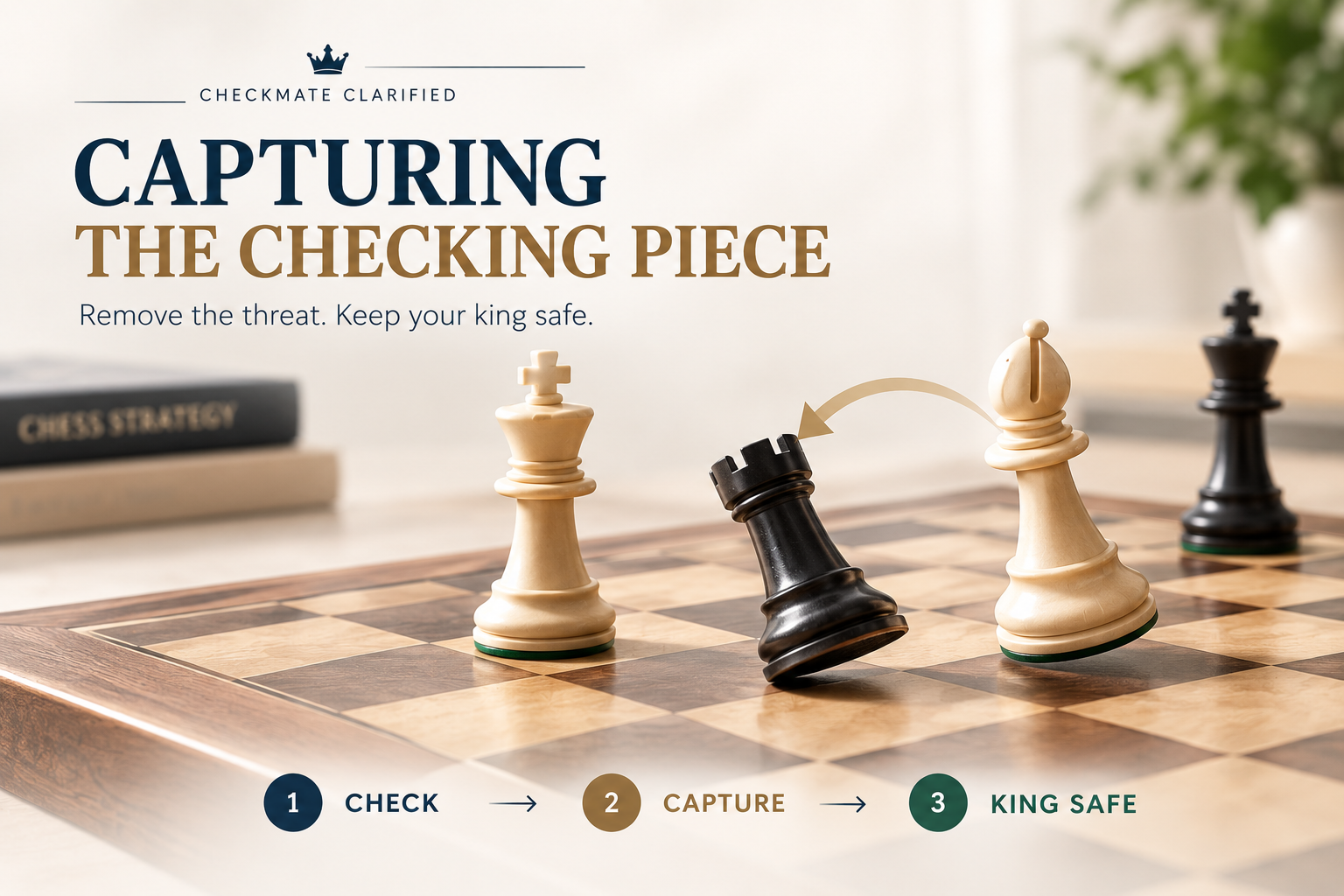
Yes — if the capture removes the check and leaves your king safe afterward. Capturing the checking piece is one of the legal ways to respond to check, but it isn’t automatic just because a piece happens to be capturable.
Start With the Checking Piece When your king is in check, first identify exactly which enemy piece is attacking it. Then ask whether you can capture that piece with one of your own. If yes, there’s one more question that decides everything: would your king actually be safe after the capture? If the capture removes the check and leaves your king clear, the move can be legal.
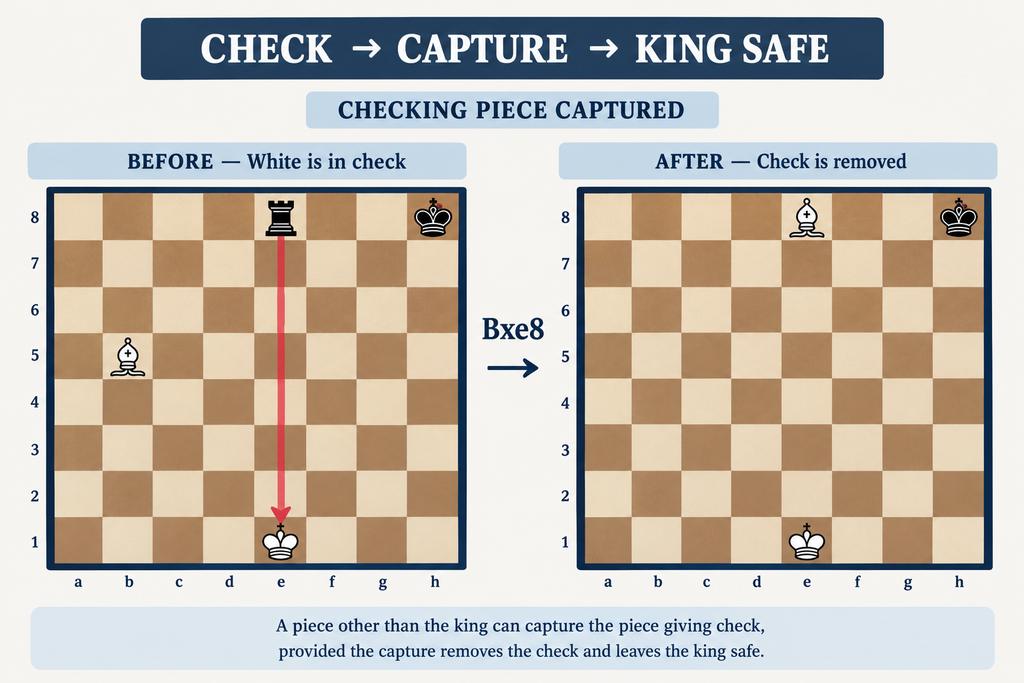
Example: A Legal Capture Imagine a black rook giving check to the white king along an open file, and White has a piece that can capture that rook. If capturing it removes the check entirely and the white king is no longer under attack, the capture is a legal response — and it doesn’t have to be the king making it. Another piece can often make the capture just as well.
What If the King Captures the Checking Piece? The king itself can also capture the checking piece, but only if the destination square is genuinely safe. Suppose a black bishop is giving check and White’s king is close enough to take it — White can’t just assume the capture works. Before playing KxB, White has to check whether another black piece attacks the square the king would land on. If it does, the king can’t make that capture at all — the same basic king-safety principle covered in the earlier article about kings capturing protected pieces.
What If Another Piece Protects the Checking Piece? That doesn’t necessarily stop a different white piece from capturing it. The only question that matters is whether the capturing move leaves White’s king safe. A white knight, for example, might be able to capture a black rook giving check even though another black piece defends that rook — if the knight can make the capture and White’s king is no longer in check afterward, the move can still be entirely legal. The capturing piece doesn’t even need to survive the exchange for the move to be legal; it just needs to result in a legal position.
What If the Checking Piece Cannot Be Captured? Then White needs another way out — moving the king to safety, blocking the attack where that’s possible, or finding some other piece that can make the capture. Blocking, though, doesn’t work against every type of check; a knight’s attack can’t be blocked, since knights jump directly to their destination squares.
Double Check Is Different There’s an important exception when the king is in double check — attacked by two pieces simultaneously. In that case, the player has to move the king. You generally can’t escape a double check by capturing one of the checking pieces or blocking one of the two attacks, because the other attack still remains active regardless.
The Real Question to Ask When you’re in check, don’t just ask “can I take the checking piece?” Ask “after I capture it, is my king completely safe?” If yes, the capture may be legal. If no, it’s illegal — and this matters especially when the king itself is making the capture, since its destination square always has to comply with the normal attacked-square rules.
Remember the three main ways to respond to ordinary check: move the king, capture the checking piece, or block the attack when that’s an option. So when your opponent gives check, don’t automatically reach for a king move — look at the whole position and find every legal response available. Sometimes the simplest solution really is just capturing the piece that gave the check in the first place.
The FIDE Laws of Chess state that a player can’t make a move that leaves or places their own king in check, with the rules governing check and legal responses covered under Articles 3.9.1 and 3.9.2. For a king capture specifically, the destination square also has to comply with the normal rules governing attacked squares. Official FIDE source: handbook.fide.com/chapter/e012023
Leave a Reply