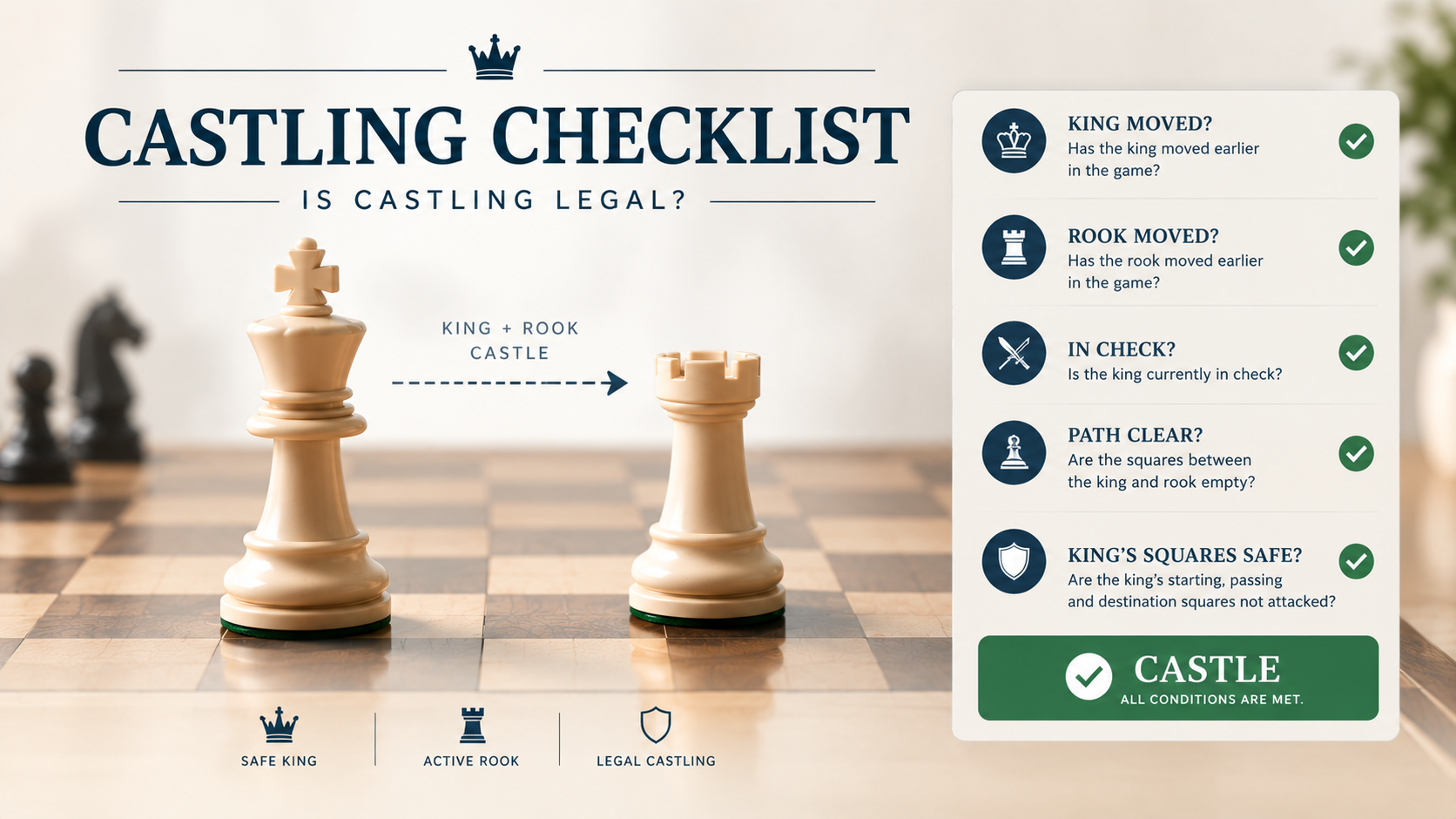
You’re looking at the board and wondering whether you can actually castle. Before you play the move, don’t guess — work through this checklist from the top, and stop as soon as you hit a “yes” on a question that rules castling out.
Step 1: Has Your King Already Moved? Yes? Stop — you can’t castle. If your king has moved at any point during the game, that right is permanently lost, regardless of whether it later returns to its original square. For example, e1 → e2 → e1 still leaves White unable to castle. If the king has genuinely never moved, continue.
Step 2: Has the Rook You Want to Castle With Moved? Yes? Stop — you can’t castle with that specific rook. For kingside castling, check the rook that started on h1 (h8 for Black); for queenside, check a1 (a8 for Black). If that particular rook has moved previously, castling with it is no longer available, though the other side may still be possible. If both king and intended rook have remained unmoved, continue.
Step 3: Is Your King Currently in Check? Yes? Stop — castling can’t be used to escape a check. You have to make a different legal move first that actually gets you out of check. If your king isn’t currently in check, continue.
Step 4: Are the Required Squares Empty? For kingside, White needs f1 and g1 empty (f8 and g8 for Black). For queenside, White needs b1, c1, and d1 empty (b8, c8, and d8 for Black). If any required square is occupied, castling on that side isn’t available.
Step 5: Are the King’s Squares Safe? This is where many players make mistakes. The king can’t castle if its starting square, crossing square, or destination square is under attack. For kingside, White’s king travels e1 → f1 → g1, so all three need to be safe. For queenside, it travels e1 → d1 → c1, so those three need to be safe — note that b1 needs to be empty but doesn’t need to be safe from attack, since the king itself never actually travels through it. The same logic applies to Black from e8.
Step 6: Check Everything Together If you’ve made it this far, run through the complete position one more time: king never moved, intended rook never moved, king not currently in check, required squares empty, king doesn’t cross an attacked square, king doesn’t land on an attacked square. If every condition holds, castling may be legal.
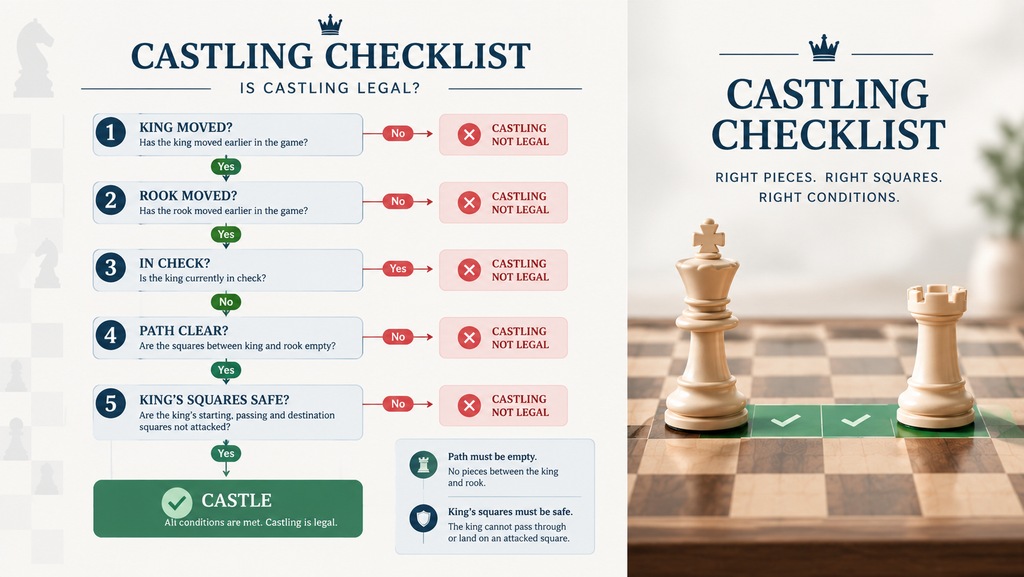
The 10-Second Castling Test King moved? No, continue. Rook moved? No, continue. King in check? No, continue. Path clear? Yes, continue. King’s squares safe? Yes — castling is legal, assuming everything else checks out.
One Last Important Point Don’t judge castling only by where the pieces currently sit — previous moves matter just as much. A king and rook can both be sitting exactly on their starting squares, and castling can still be completely illegal, because one of them moved earlier in the game and simply returned. That’s exactly why the full checklist matters, rather than just eyeballing the current position.
The castling conditions are covered by Article 3.8.2 of the FIDE Laws of Chess, with the loss of castling rights and the temporary restrictions explained specifically in Articles 3.8.2.1 and 3.8.2.2. The key idea throughout is simple: before you castle, check the king, the rook, the path between them, and the attacked squares — if every required condition is satisfied, the move may be legal. Official FIDE source: handbook.fide.com/chapter/e012023
Leave a Reply