No. You can’t castle if there’s any piece sitting between the king and the rook — the squares between them have to be completely empty, on both the kingside and the queenside, regardless of whether the king would otherwise be perfectly safe.
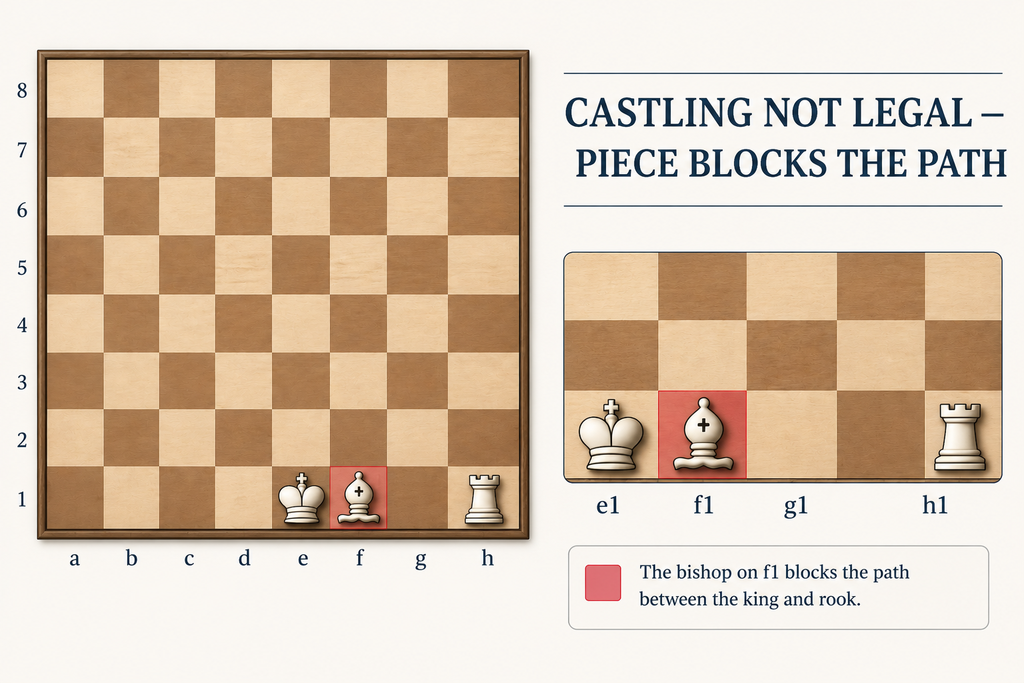
Why Must the Squares Between Them Be Empty? Castling involves both the king and a rook moving simultaneously — the king moves two squares toward the rook, while the rook jumps to the square immediately on the other side of the king. For that move to physically happen, there simply can’t be another piece occupying the space in between. Take White’s normal kingside castling setup: king on e1, rook on h1, with f1 and g1 needing to be empty. If a piece is sitting on either one, White can’t castle kingside at all.
What About Queenside Castling? The same principle applies queenside, just with more squares involved. White’s king starts on e1 and the queenside rook on a1, so the squares b1, c1, and d1 all have to be empty before White can castle that direction. Even one piece remaining on any of those three squares rules out queenside castling entirely.
It Doesn’t Matter Which Piece Is Blocking the Way The blocking piece can belong to either side. If White’s own knight is still sitting on g1, that blocks White’s kingside castling exactly as much as an enemy piece would. The square just needs to be empty — whose piece is occupying it is beside the point.
What About an Attacked Square? This is a genuinely separate requirement, and both have to be satisfied simultaneously. The squares between king and rook have to be empty, and independently, the king’s starting square, the square it crosses, and its landing square all have to be free of attack. For kingside castling, White needs e1, f1, and g1 all safe from attack, f1 and g1 both empty, and neither the king nor the h1 rook to have moved previously. For queenside, White needs e1, d1, and c1 safe from attack, and b1, c1, and d1 all empty, plus the same no-prior-movement requirement for the king and a1 rook.
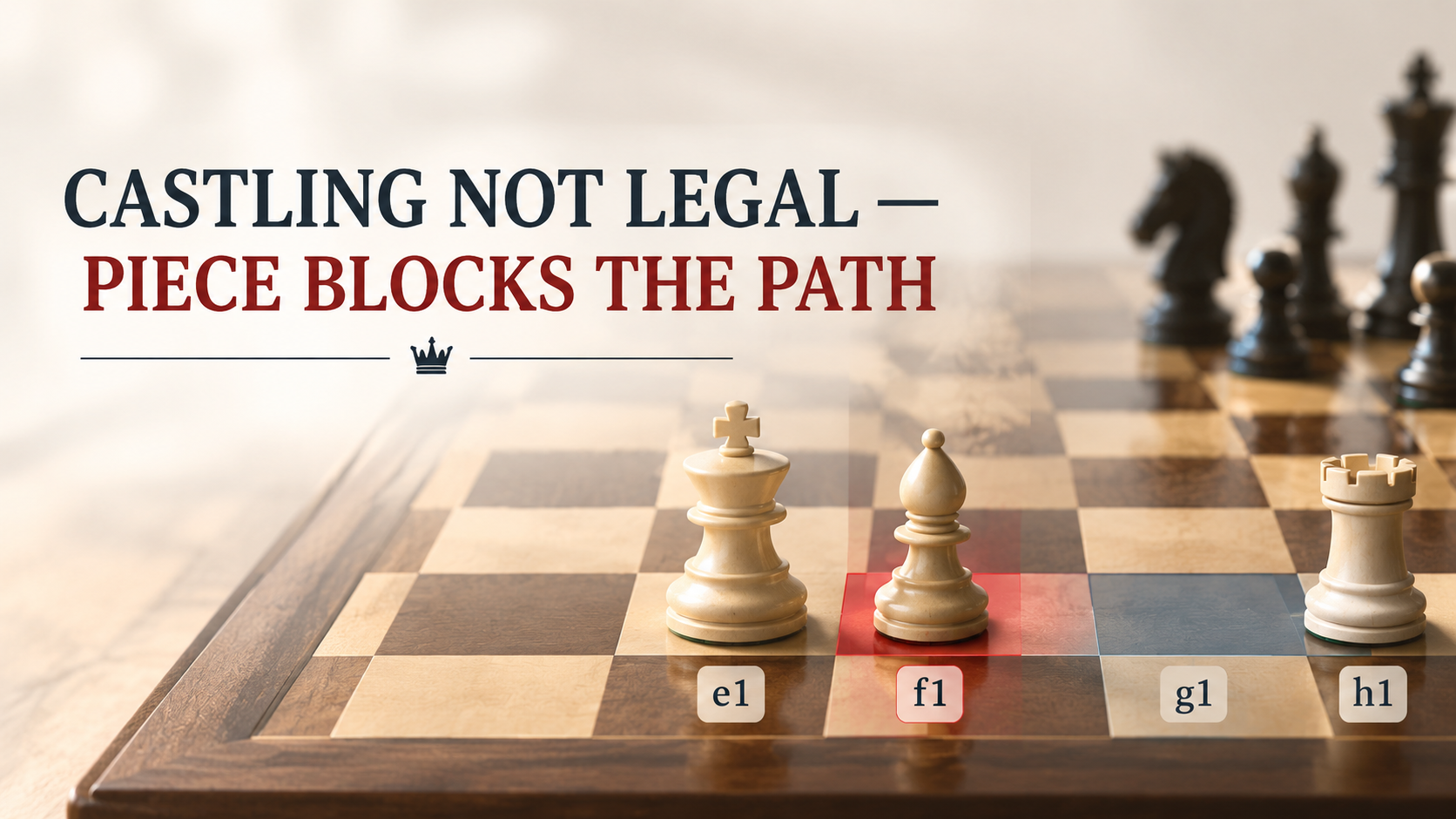
A Simple Example Imagine White wants to castle kingside — king on e1, rook on h1, everything looking perfectly safe, except White’s own bishop is still sitting on f1. White can’t castle. The bishop sits directly between the king and rook, blocking the required path, even though it poses no threat to the king at all. Once that bishop moves and every other condition is satisfied, castling may become available.
Before castling, check two separate things: is the king’s path actually safe, and is the space between king and rook genuinely empty? If a piece is blocking that space, castling isn’t allowed regardless of anything else. For White specifically, kingside needs f1 and g1 empty, and queenside needs b1, c1, and d1 empty — the same logic applies to Black from its own starting squares.
The FIDE Laws of Chess cover this requirement under Article 3.8.2.2.
Leave a Reply