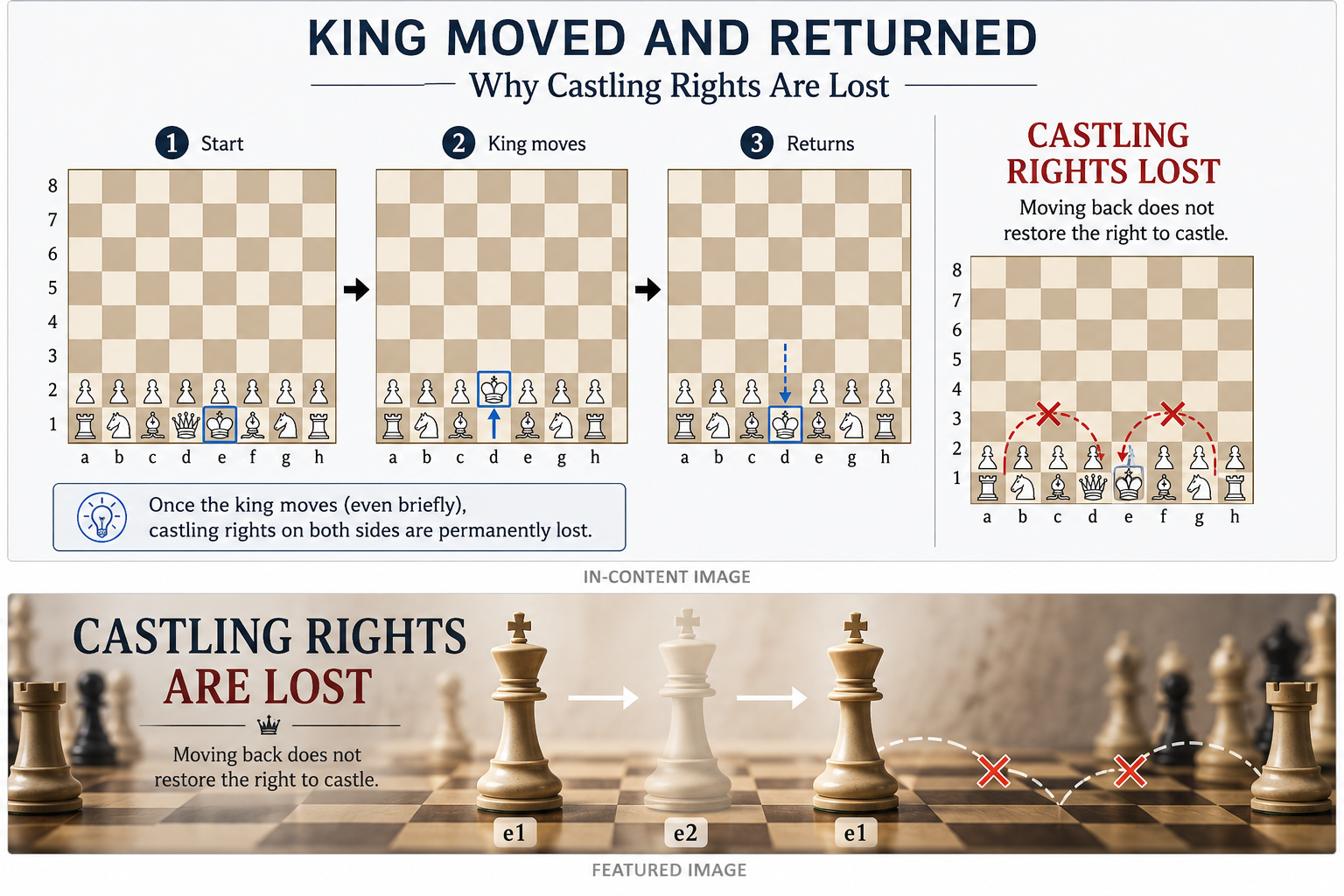
Can you castle if your king has moved back? No. If your king has moved at any point during the game — even once, even if it comes right back to its original square — you can no longer castle. This is one of the easiest castling rules to misunderstand, because the position on the board can look completely normal afterward.
Why Can’t the King Castle After Moving Back? Castling isn’t determined only by where the pieces currently sit — it also depends on whether the king and the relevant rook have moved previously, at any point. Under FIDE Article 3.8.2.1, the right to castle is lost the moment the king (or the intended rook) moves, and it stays lost. For example, imagine White’s king goes from e1 to e2, and later moves back from e2 to e1. The king is now sitting exactly where it started. But White still can’t castle — the king already moved once, and that permanently ended the castling right the instant it left e1.
What If the King Only Moved Once? It doesn’t matter how many times it moved, or how briefly. Even a single legal king move is enough — e1 to f2 and back to e1 produces the exact same result as the simpler example above. The same applies if the king moved specifically to escape check; returning to the original square afterward does not restore the lost right.
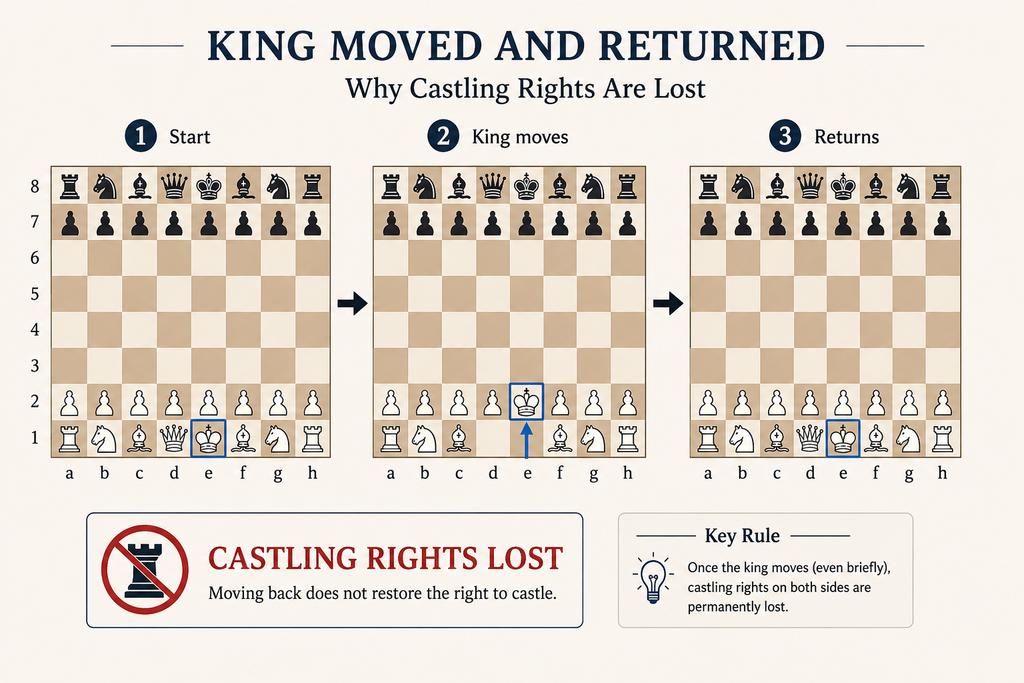
What About the Rook? The identical principle applies to the specific rook involved in castling. If White’s king has never moved but the h1 rook goes to h2 and back to h1, White has lost the right to castle kingside with that rook. This only affects castling with that particular rook, though — if the other conditions are satisfied, moving the h1 rook doesn’t touch White’s queenside castling right, since that involves a different rook entirely.
A Simple Example Imagine this full sequence: White’s king starts on e1, moves to e2, and later moves back to e1. White clears the squares between king and rook. The king isn’t in check, and the relevant squares aren’t under attack. White still can’t castle. The board may look exactly like a position where castling would normally work, but the earlier king move already erased that right.
If you’re wondering whether you can castle, the question to ask isn’t about the current position at all — it’s “has my king ever moved?” If yes, you can’t castle for the rest of the game, and moving it back changes nothing.
The Easy Rule to Remember
If you’re wondering whether you can castle, ask:
“Has my king ever moved?”
If yes, you cannot castle for the rest of the game.
Moving the king back does not reset the rule.
The same idea applies to the rook being used for castling: if that rook has already moved, you cannot castle with it later.
The Official Rule
The rule is found in Article 3.8.2.1 of the FIDE Laws of Chess.
It states that the right to castle has been lost if the king has already moved, or if the rook with which castling is intended has already moved.
Official FIDE source: https://handbook.fide.com/chapter/e012023
Leave a Reply