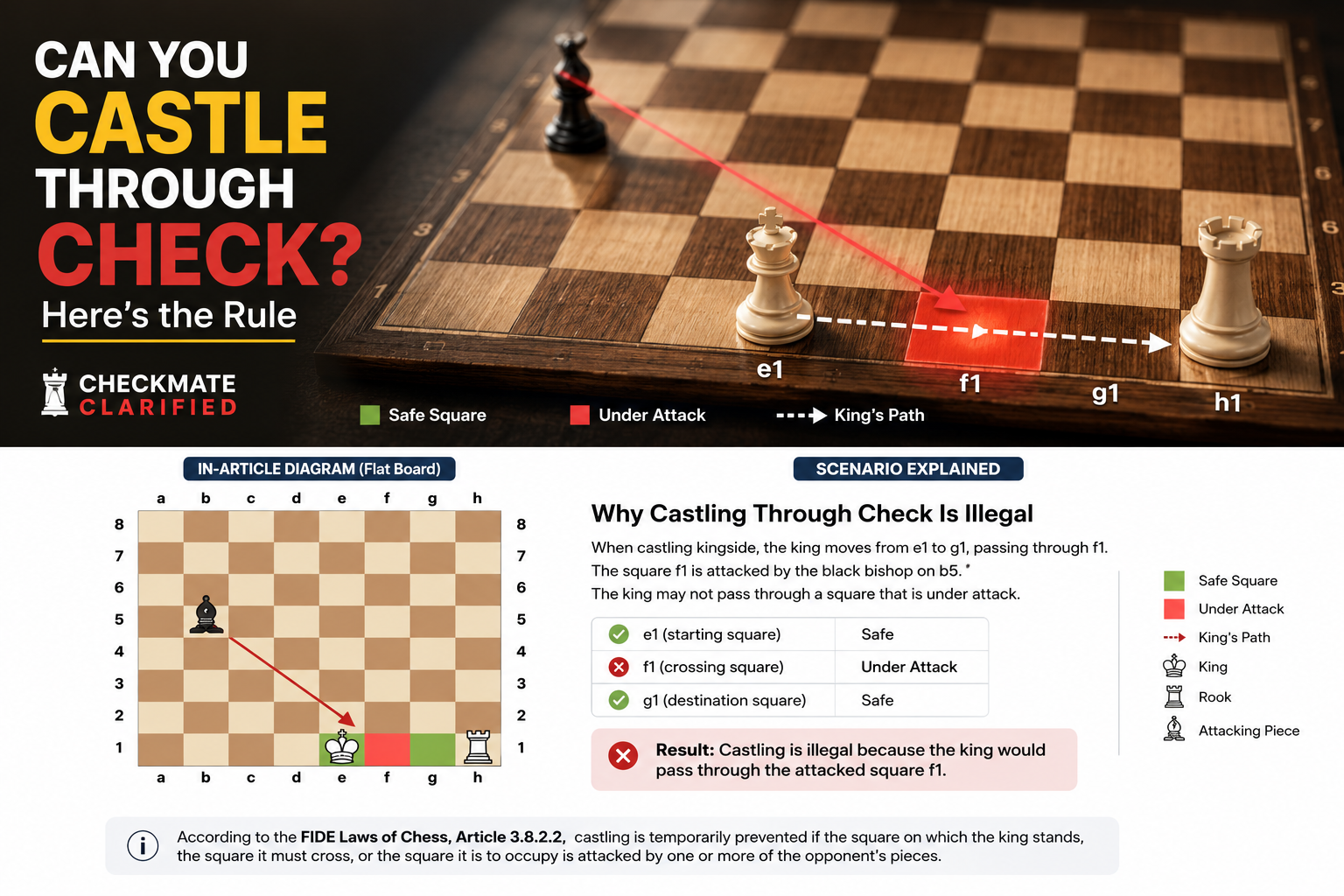
Can you castle through check? No, you cannot. When you castle, your king moves two squares toward the rook — and during that move, it can’t pass through a square that’s under attack, even if the squares it starts on and ends on are both completely safe.
What Does “Through Check” Mean? Consider a normal kingside castling setup for White. The king starts on e1 and wants to castle to g1, passing through f1 along the way. For castling to be legal, none of e1, f1, or g1 can be under attack. So even if the king’s starting square and its destination are both safe, an attack on f1 alone is enough to prevent castling entirely. The same logic applies to queenside castling — the king moves from e1 through d1 to c1, so none of those three squares can be attacked either.
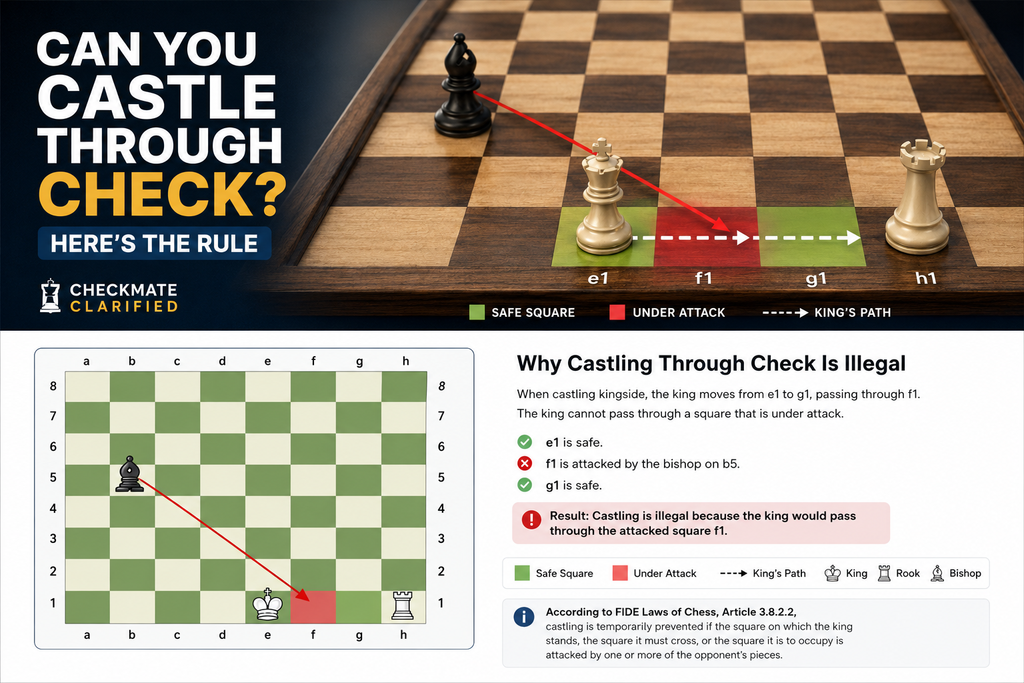
An Example Imagine White wants to castle kingside, e1 and g1 are both safe, but a black bishop is attacking f1. White cannot castle. The king would have to pass through f1 on the way to g1, and that square is under attack — because the king isn’t allowed to move through an attacked square while castling, the move is illegal, full stop. Once that attack on f1 is removed, castling may become legal again, assuming every other condition is satisfied.
What If the Rook Is Under Attack? This is a different situation entirely. An attack on the rook itself doesn’t, by itself, prevent castling — the squares that actually matter for the king are its starting square, the square it crosses, and its destination. So if a black piece attacks the rook on h1 but doesn’t touch e1, f1, or g1, White can still castle kingside, as long as neither the king nor that rook has moved previously and nothing sits between them. It’s worth not confusing an attacked rook with an attacked crossing square — they’re separate issues entirely.
What If the King Is Currently in Check? That’s also illegal — a player can’t castle while their king is currently in check, and has to resolve the check with some other legal move first. But escaping check doesn’t necessarily destroy the right to castle going forward; if the king never actually moved and the relevant rook never moved either, castling rights can remain available for later.
For castling, ask three questions: is the king’s starting square safe? Is the square it crosses safe? Is its destination safe? If any of those three is attacked, castling isn’t allowed — for kingside that’s e1 → f1 → g1, for queenside it’s e1 → d1 → c1. The rook’s own path isn’t subject to the same attack restriction; the special rule concerns specifically the king and the squares it occupies or crosses.
The FIDE Laws of Chess state that castling is temporarily prevented when the square occupied by the king, the square it must cross, or the square it’s to occupy is attacked by one or more of the opponent’s pieces — this is covered under Article 3.8.2.2. So the answer stays simple: you cannot castle through check, even if the king’s starting and final squares are both perfectly safe. FIDE Laws of Chess.
Leave a Reply