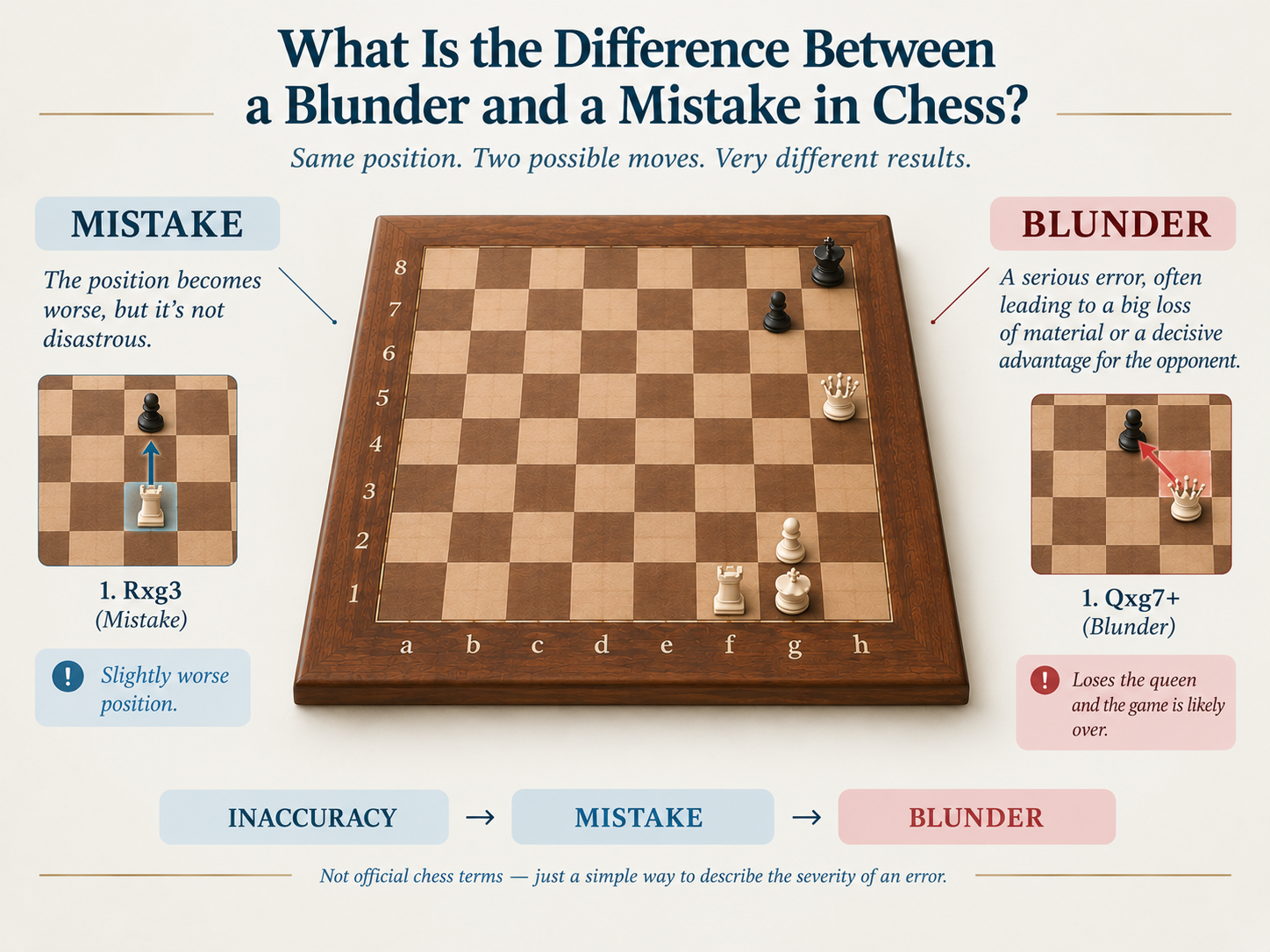
The difference between a blunder and a mistake in chess usually comes down to how seriously the move damages your position.
There’s no official FIDE definition for either “blunder” or “mistake” — both are common chess terms used by players, coaches, commentators, and chess engines, and there’s no precise rule that separates one from the other. So how do you actually tell them apart in practice?
Step 1: Did the Move Make Your Position Worse? If yes, you made a mistake. Imagine you have a good position but move the same piece unnecessarily several times, losing some of your advantage in the process — your move might not immediately lose material or the game outright, but it does make your position weaker. That’s a mistake.
Step 2: Did You Lose Material? If your move lets your opponent win a piece, rook, or queen for little or nothing, you’re moving into blunder territory. Leaving your queen undefended and watching your opponent capture it, without a strong tactical reason behind the sacrifice, would normally be called a blunder.
Step 3: Did You Miss a Simple Tactical Threat? A move can also be a blunder if it completely overlooks something the opponent can do immediately — missing a checkmate threat, a hanging piece, a fork, a discovered attack, a decisive capture, or a promotion threat all fall into this category. The bigger and more immediate the consequence, the more likely players are to call it a blunder rather than a mere mistake.
Step 4: Did the Evaluation Change Dramatically? Chess engines make this distinction easier to see in practice. If your position was roughly equal before your move, and your opponent suddenly has a major advantage after it, players tend to describe that as a blunder — though there’s no universal numerical threshold that officially separates the two labels, and different platforms use them somewhat differently.
A Simple Decision Path Did the move make your position worse? That’s a mistake. Did it also lose significant material or create a major tactical problem? That’s likely a blunder. Did it completely swing the game in your opponent’s favor? That’s a strong candidate for a blunder. Remember these aren’t official FIDE classifications — they’re practical shorthand for describing how serious an error was.
Mistake vs. Blunder
| Mistake | Blunder | |
|---|---|---|
| Severity | Usually smaller | Usually serious |
| Position | Becomes worse | Can become dramatically worse |
| Material | May not lose material | Often loses material |
| Tactical consequence | May be limited | Often immediate or decisive |
| Official FIDE term? | No | No |
What About an Inaccuracy? You’ll also see a third label — inaccuracy — describing a smaller deviation from the objectively strongest move. The rough progression runs inaccuracy, then mistake, then blunder, from relatively small to increasingly serious. Again, these are conventions rather than official FIDE categories.
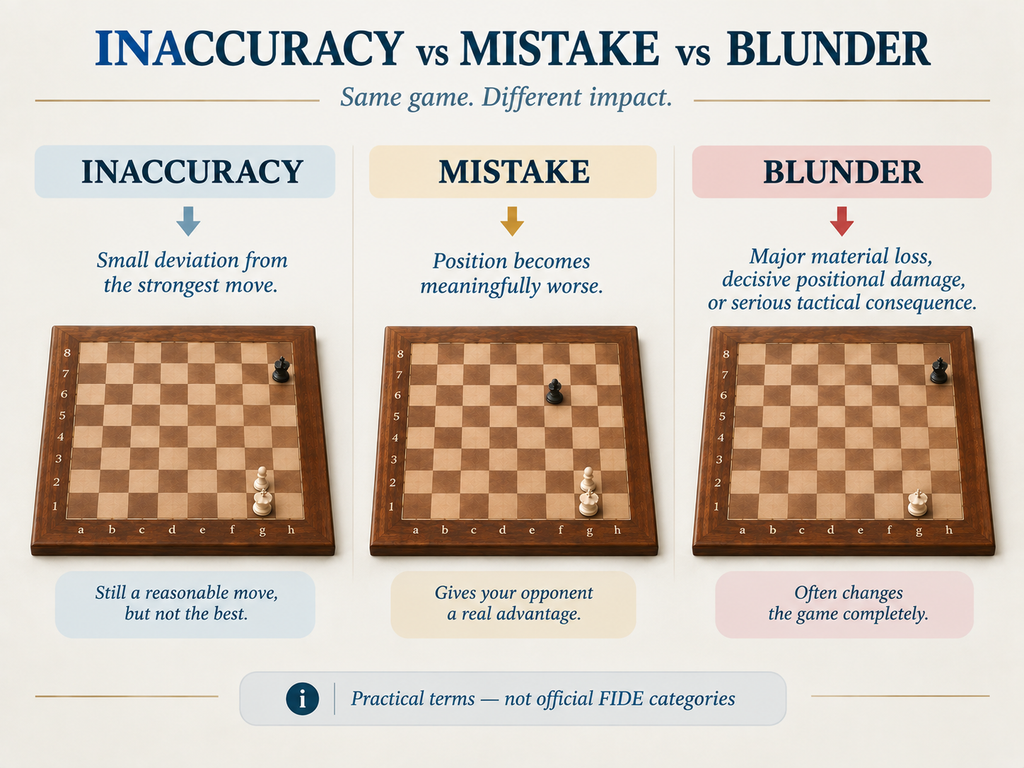
How to Avoid Blunders Before making a move, build the habit of running through checks, captures, and threats: what checks does my opponent have? What can they capture? What are they threatening? Is the piece I’m about to move currently defending something important? And after my move, what’s my opponent’s strongest response? This simple routine catches a surprising number of avoidable tactical errors before they happen.
FIDE doesn’t define “blunder,” “mistake,” or “inaccuracy” as official categories anywhere in the Laws of Chess — those are descriptive terms that belong to the chess community, not the rulebook. The official Laws instead define things like legal moves, captures, check, and checkmate. Source: FIDE Laws of Chess, official handbook.
A mistake generally makes your position worse. A blunder is a much more serious version — significant material loss, a decisive positional disadvantage, or even immediate tactical defeat. The exact boundary isn’t official or universal, so don’t get too hung up on the label. The more useful question when reviewing your own games is simply what you missed, and how to catch it next time.
Leave a Reply