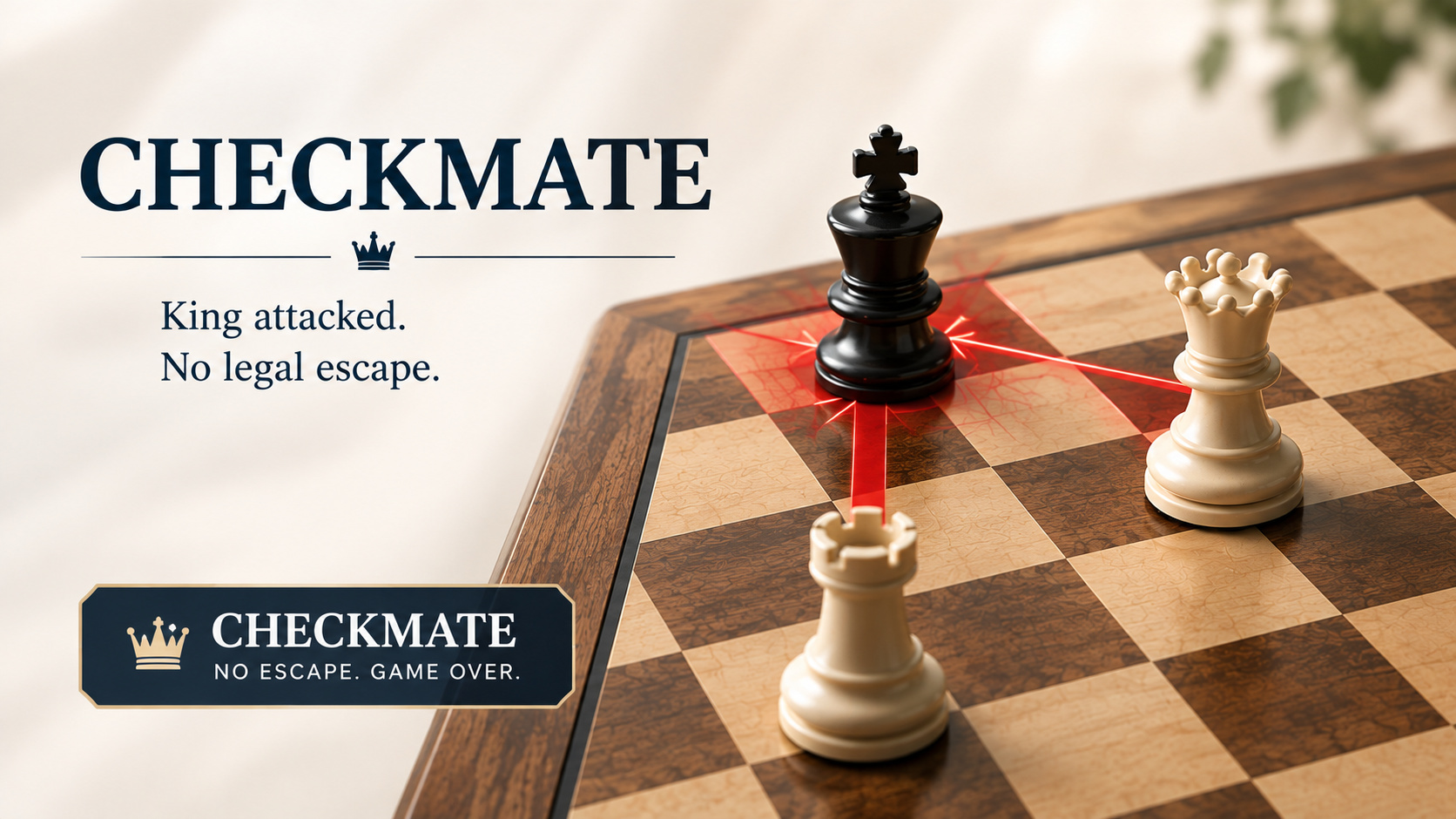
Check and checkmate are not the same thing.
In both check and checkmate, the king is under attack — so the difference between the two has nothing to do with whether that attack exists. It comes down entirely to whether the player has a legal way to escape it.
Check: The King Is Under Attack A king is in check when an opponent’s piece attacks it — a rook along an open file, a bishop along a diagonal, whatever the case may be. When this happens, the player has to respond, and that response might be moving the king to a safe square, capturing the checking piece, or blocking the attack when the type of check allows it. As long as at least one legal response exists, the position is check, not checkmate.
Checkmate: There Is No Escape Checkmate occurs when the king is in check and there’s no legal way to get out of it at all — the king can’t move to a safe square, the checking piece can’t be captured, and the attack can’t be blocked when blocking would otherwise be possible. Once every legal response is unavailable, the position is checkmate, and the game ends immediately.
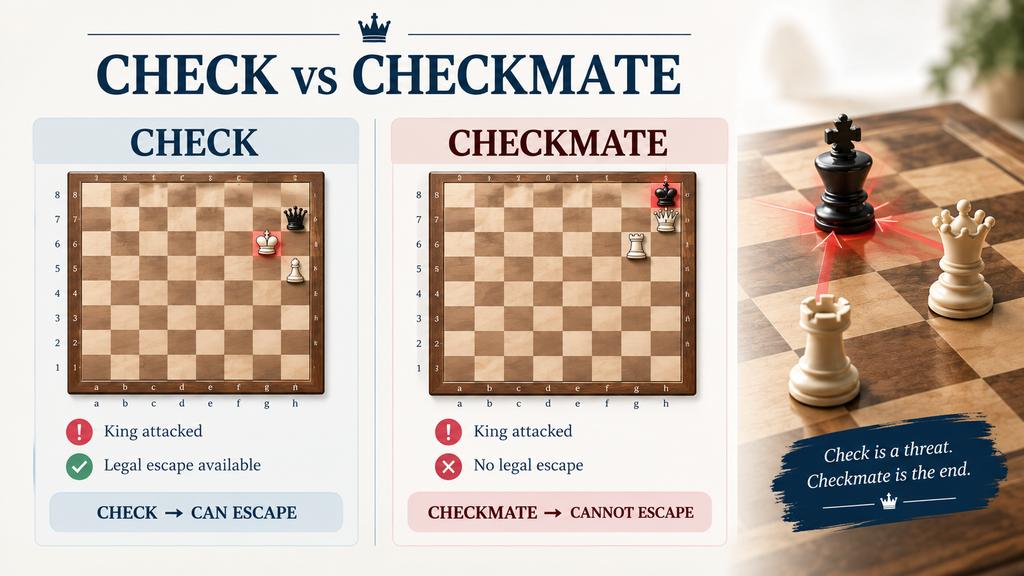
Check vs. Checkmate
| Check | Checkmate | |
|---|---|---|
| King in check? | Yes | Yes |
| At least one legal response exists? | Yes | No |
| Result | The game continues | The game ends |
| Player must respond? | Yes | No legal escape available |
The key difference, again, is not whether the king is under attack — in both cases it is. It’s entirely about whether the player has a legal response left.
A Simple Example Imagine a black rook attacking the white king along a file. If White can move the king to a safe square, that’s check. If White can’t move the king but can capture the rook with another piece instead, that’s still only check. If White can’t move the king, can’t capture the rook, and can’t block the attack, the position becomes checkmate. It’s worth noting the checking piece itself doesn’t have to be captured for checkmate to be avoided — any legal response that removes the check does the job.
What About Stalemate? This is another position frequently confused with checkmate. In stalemate, the player has no legal move, but the king isn’t in check. In checkmate, the king is in check and there’s no legal way to escape. So: checkmate is king-attacked-plus-no-legal-response; stalemate is king-not-attacked-plus-no-legal-move. That single distinction is genuinely important.
The Quick Test When you’re unsure whether a position is check or checkmate, ask: is the king currently under attack? If no, it’s neither. If yes, ask whether there’s at least one legal way to remove the check. If yes, it’s check. If no, it’s checkmate.
The FIDE Laws of Chess define check as a king attacked by one or more of the opponent’s pieces, and state that the objective of the game is to checkmate the opponent’s king — meaning the king is under attack and can’t escape by any legal move. These principles are covered under Articles 3.9.1 and 3.9.2. Official FIDE source: handbook.fide.com/chapter/e012023
Leave a Reply