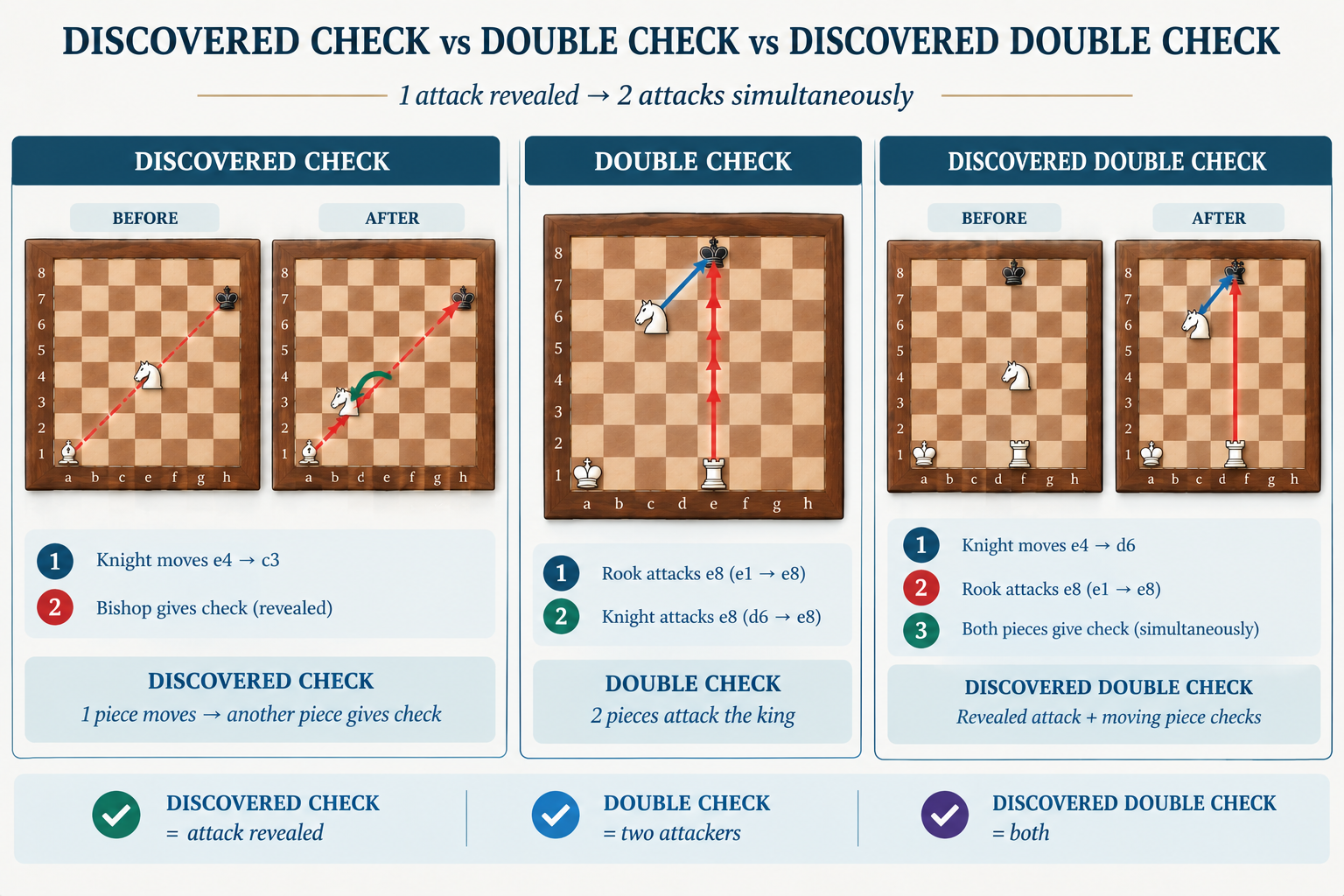
The difference between discovered check and double check comes down to how many pieces are attacking the king.
Here’s a small paradox worth sitting with: every double check involves a discovered attack, but not every discovered check is a double check. The confusion between the two usually comes down to one simple question — how many pieces are attacking the king right now?
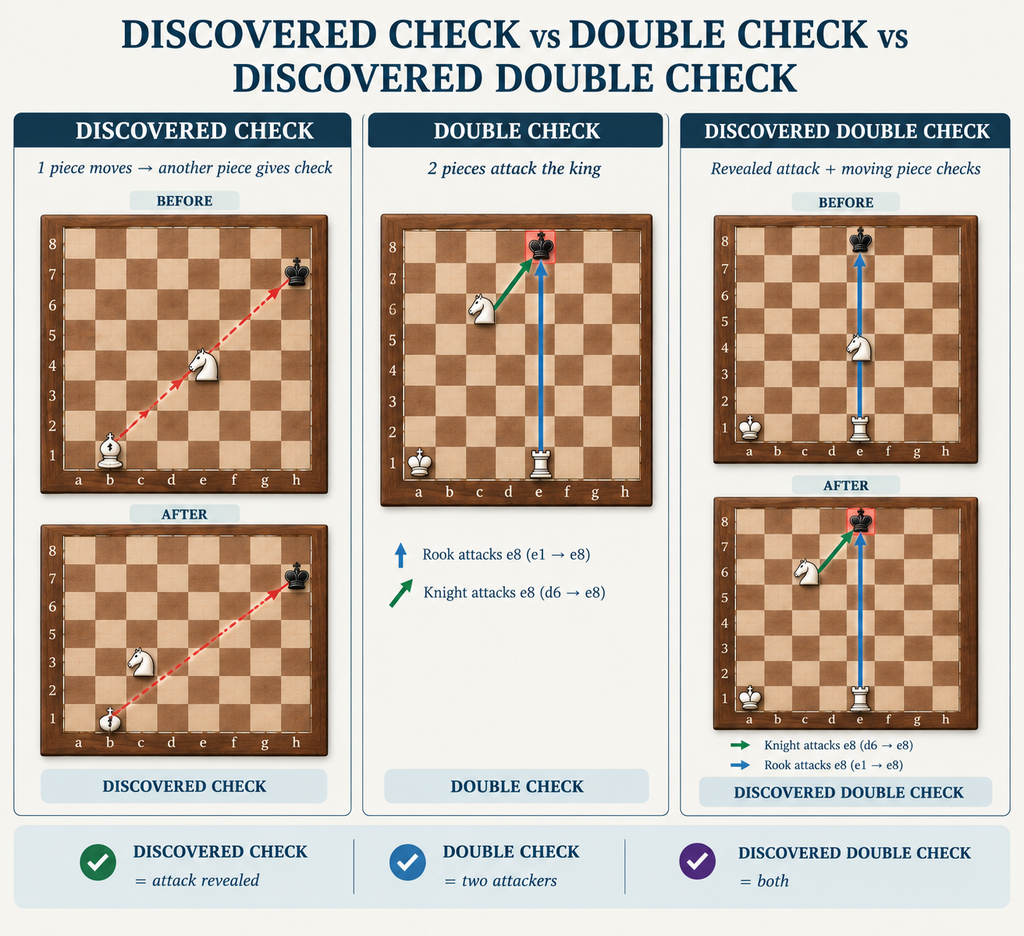
What Is a Discovered Check? A discovered check happens when a piece moves and reveals an attack from a different piece behind it. Say a white bishop is aimed at the black king but a white knight is blocking the diagonal — the knight moves away, the bishop’s line opens, and the black king is in check, delivered by the bishop even though the knight is what actually moved.
What Is a Double Check? A double check goes a step further: two pieces attack the king at the same moment. This happens when the piece that moves not only reveals the hidden attacker’s line, but also attacks the king itself from its new square. Now both the newly revealed piece and the piece that just moved are checking the king simultaneously.
Side-by-Side Comparison
| Discovered Check | Double Check | |
|---|---|---|
| Number of checking pieces | At least one newly revealed attacker | Two attackers |
| How it happens | A piece moves and reveals an attack | Two attacks exist simultaneously |
| Does the moving piece have to give check? | No | Often yes when created by the move |
| Can it involve a discovered attack? | Yes | Yes |
| How must the king respond? | Any legal response that removes the check | The king must move |
Why Is Double Check So Powerful? In ordinary check, you may be able to move the king, capture the checking piece, or block the attack. In double check, none of that works as cleanly — capturing one checking piece doesn’t normally remove the other attack, and blocking one line doesn’t remove the second one either. The only practical legal response to a double check is moving the king to a safe square.
Can a Discovered Check Be a Double Check? Yes — this is exactly where the two concepts overlap. Imagine a white knight blocking a black king from a white rook. The knight moves, the rook’s attack is revealed as a discovered check — but suppose the knight’s new position also directly attacks the black king. Now the king is attacked by both the rook and the knight simultaneously. That’s a double check created by a discovered check.
How to Tell Which One You’re Seeing Ask whether another piece’s attack became exposed — if yes, that’s a discovered check. Ask separately whether two pieces are attacking the king at once — if yes, that’s a double check. If only one piece is attacking, it isn’t a double check, though it may still be a discovered one.
A Simple Example Imagine a white bishop lined up with the black king while a white knight blocks the diagonal. White moves the knight away. If only the bishop now attacks the black king, that’s a discovered check. If the knight also attacks the black king from its new square, that’s a discovered double check. That small distinction can completely change how the defending player has to respond.
Neither term appears as a distinct rule in the FIDE Laws — both arise from the normal rules governing piece movement and check. Article 3.9.1 defines check as an attack by one or more opponent pieces, while Article 3.9.2 requires that a player’s move never leave their own king under attack. Official FIDE source: handbook.fide.com/chapter/e012023
Leave a Reply