Does the King Have to Move When in Check?
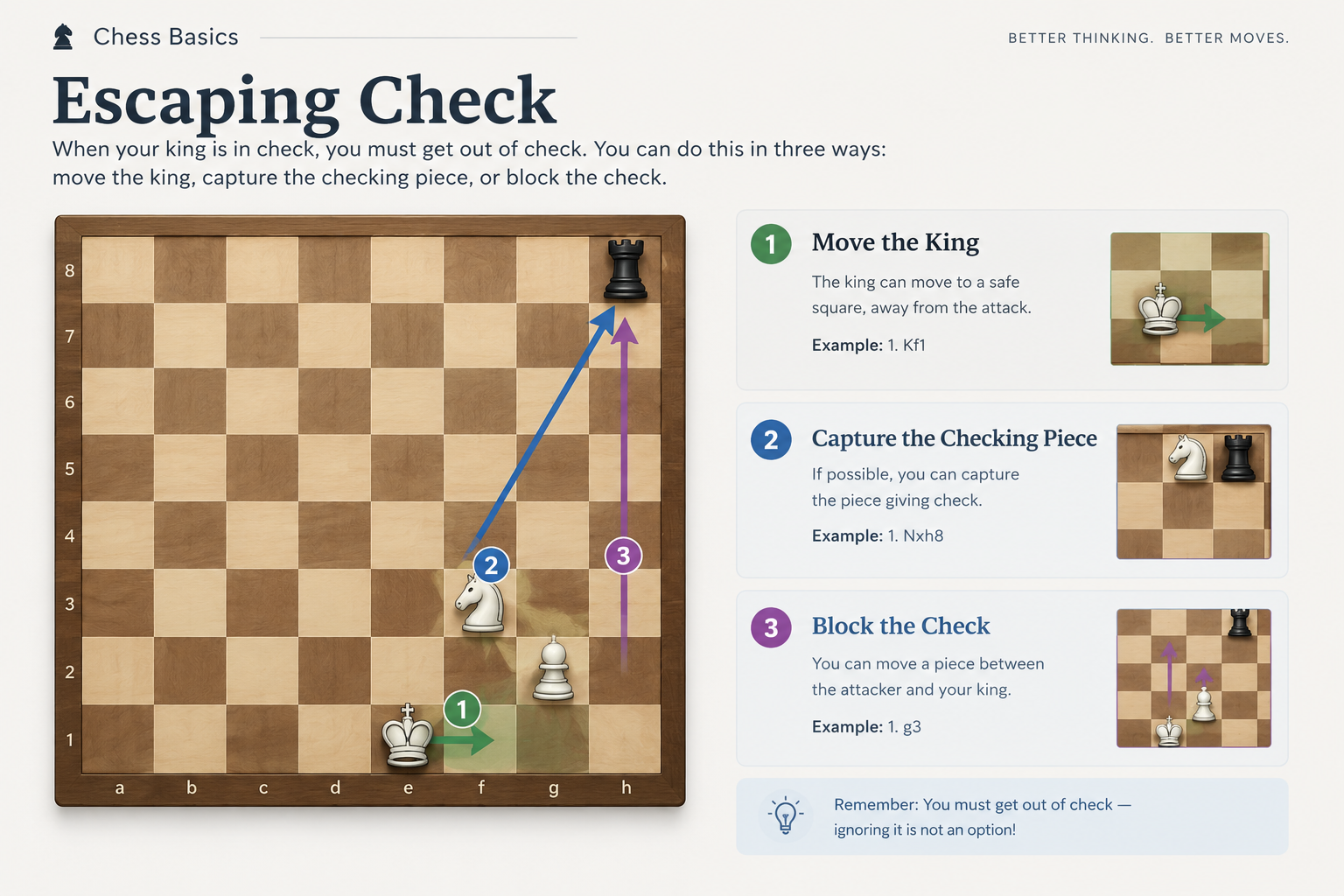
Not necessarily. When your king is in check, you have to make some legal move that resolves the check — but that move doesn’t always have to involve the king itself. Depending on the position, you may be able to capture the checking piece or block the attack instead.
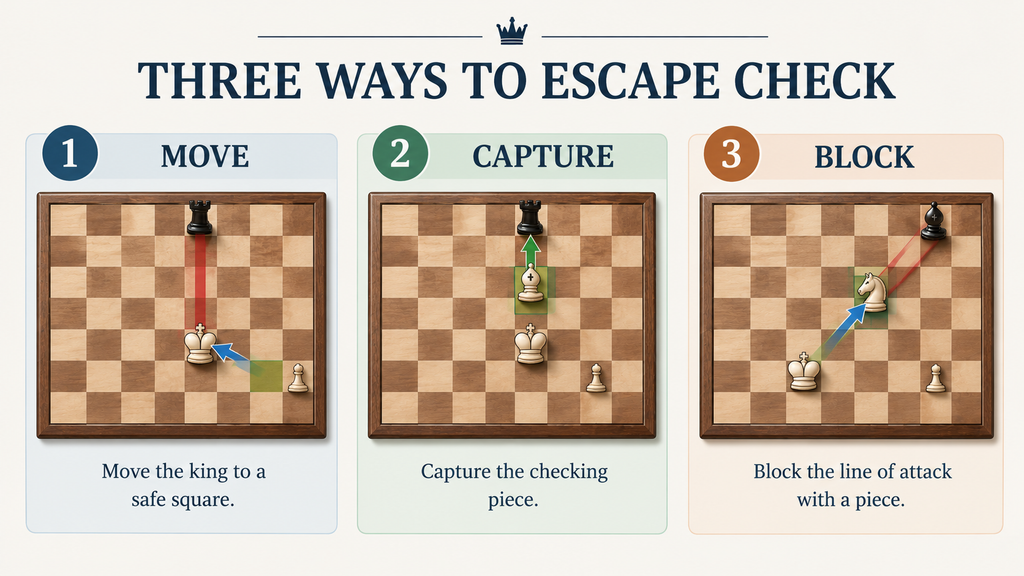
The Three Ways to Escape Check There are three basic responses available. The first is moving the king to a square that isn’t under attack — if a rook is giving check along a file, for example, the king may be able to slide to a safe neighboring square, though the destination square always has to genuinely be safe. The second is capturing the checking piece outright, which is only legal if doing so doesn’t leave the king in check afterward — if an enemy bishop giving check can be safely captured by the king, that capture works; but if another enemy piece defends that bishop, the king can’t take it if doing so would land it on an attacked square. The third is blocking the attack, which only works against checks delivered along a line by a rook, bishop, or queen — if a black rook is checking along a rank, White might be able to place a piece between the rook and the king to stop it. Blocking simply isn’t possible against a knight’s attack, since a knight attacks its destination directly rather than along a line.
When Does the King Actually Have to Move? Sometimes none of the alternatives are available. If the checking piece can’t be captured, the attack can’t be blocked, and there’s no other safe way to remove the check, then the king genuinely has to move. This is why it helps to think “how can I get my king out of check?” rather than “where can my king move?” — the first question considers every legal response, not just king moves.
What If You Ignore the Check? You can’t simply make a different move while your king remains in check — your move has to leave your king safe, full stop. If your king is in check and you move a different piece without actually removing the check, that move is illegal. In a real game, you have to resolve the check before play continues in any other direction.
Checkmate Is Different If the king is in check and there’s no legal way to escape it at all — the king can’t move to safety, the checking piece can’t be captured, and the attack can’t be blocked when blocking would otherwise be possible — the position is checkmate, and the game ends immediately.
Being in check means your king is under attack and you have to respond, but it doesn’t automatically mean the king itself must move. Your legal options depend entirely on the position: you might move the king, capture the checking piece, or block the attack. The goal is always the same regardless of which route you take — your king must no longer be in check after your move.
The FIDE Laws of Chess state that a player is considered to be in check when their king is attacked by one or more of the opponent’s pieces, and that a player can’t make a move that leaves or places their own king in check. These principles are covered by Articles 3.9.1 and 3.9.2. Official FIDE source: handbook.fide.com/chapter/e012023
Leave a Reply