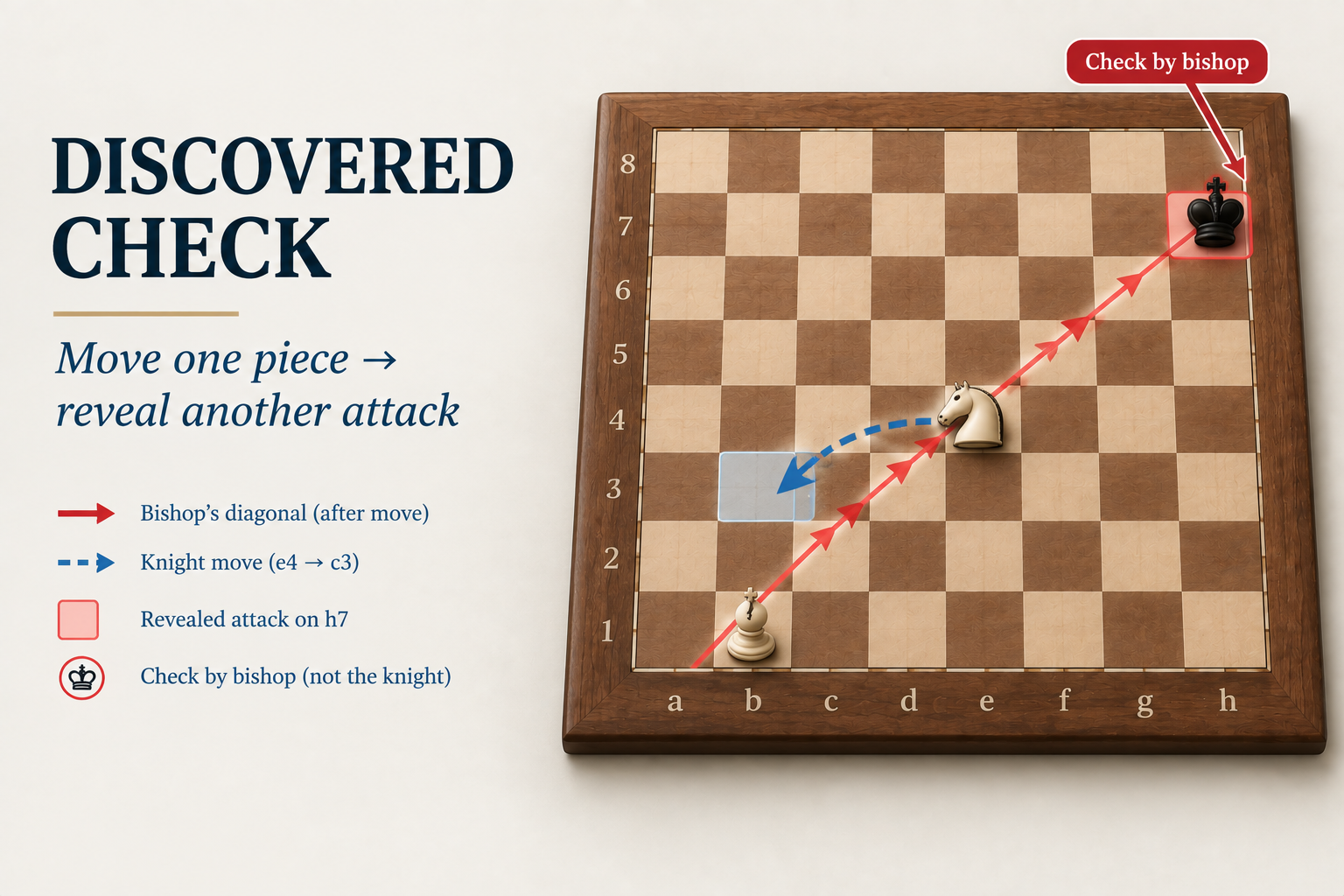
What is a discovered check?
Picture this: a white bishop sits on b1, lined up diagonally toward a black king on h7, except a white knight is sitting on e4, right in the way, blocking that diagonal. The bishop can’t touch the king. Then White moves the knight somewhere else entirely — the diagonal opens up, and suddenly the black king is in check, not because of anything the knight did directly, but because moving it uncovered the bishop’s attack. That’s a discovered check: one piece moves aside, and a completely different piece delivers the check.
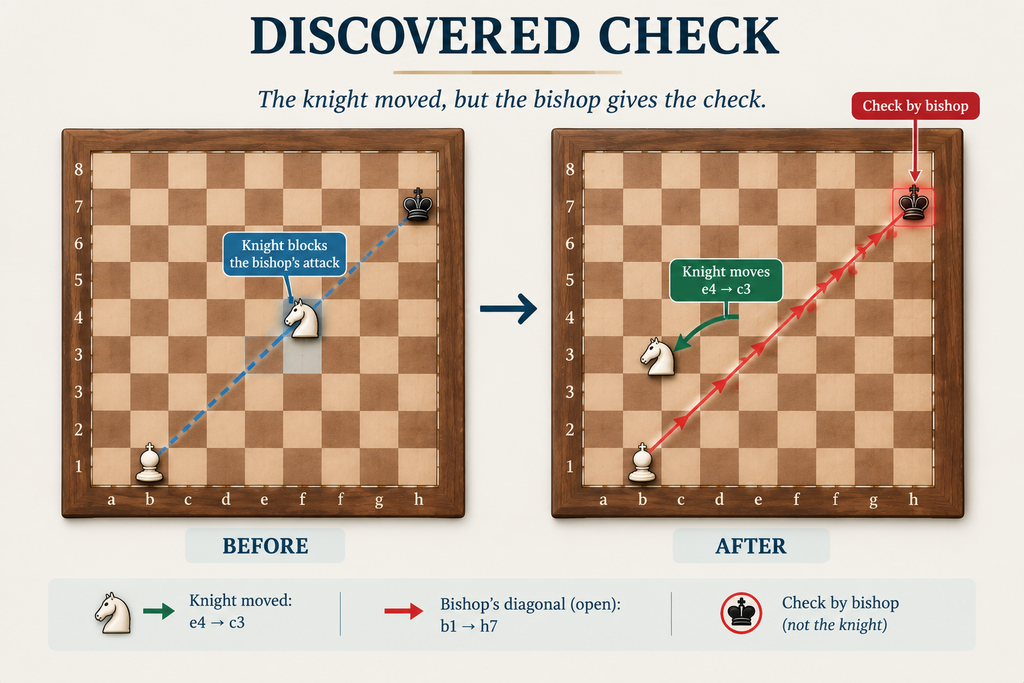
The Three Pieces to Identify When looking for a discovered check, identify three things: the king being attacked, the hidden attacking piece — usually a bishop, rook, or queen whose line toward the king was blocked — and the moving piece that clears the path. Once the moving piece steps aside, the hidden attacker’s line reaches the king, even though that attacker never moved at all.
Why Is Discovered Check Powerful? This tactic tends to be especially dangerous because the piece that moves is often free to do something useful at the same time. It might capture another piece, attack the queen, threaten checkmate, or simply relocate to a strong square — and the opponent is forced to deal with the check first, before addressing whatever else that moving piece just accomplished. That combination is what gives discovered checks their tactical bite.
Discovered Check vs. Ordinary Check The distinction is worth being precise about. In an ordinary check, the piece you move gives the check directly — a rook slides onto a file and attacks the enemy king itself. In a discovered check, the piece that moves isn’t the one attacking at all; it’s simply clearing a path for something that was already positioned to strike. The checking piece was on the board the whole time.
What About a Double Check? Occasionally a discovered check becomes something stronger: a double check, where the moving piece both reveals the hidden attacker’s line and gives check itself, simultaneously. Now two pieces are attacking the king at once, which is a heavier restriction on the defender, since a double check generally can only be answered by moving the king — capturing or blocking one of the two attackers still leaves the other one checking.
How to Spot a Discovered Check When scanning a position, ask whether one of your own pieces is standing between an enemy king and your bishop, rook, or queen. If moving that piece would open the line, and the newly opened line reaches the king, you’ve found a discovered check.
The underlying idea is simple to hold onto: move one piece, reveal another piece, and the king ends up in check. It’s a good reminder to always look beyond the piece that’s currently moving — sometimes the real threat is hiding behind it.
FIDE doesn’t treat discovered check as a separate special rule; it emerges naturally from the ordinary movement and check rules. Article 3.9.1 defines a king as in check when it’s attacked by one or more opponent pieces. Official FIDE source: handbook.fide.com/chapter/e012023
Leave a Reply