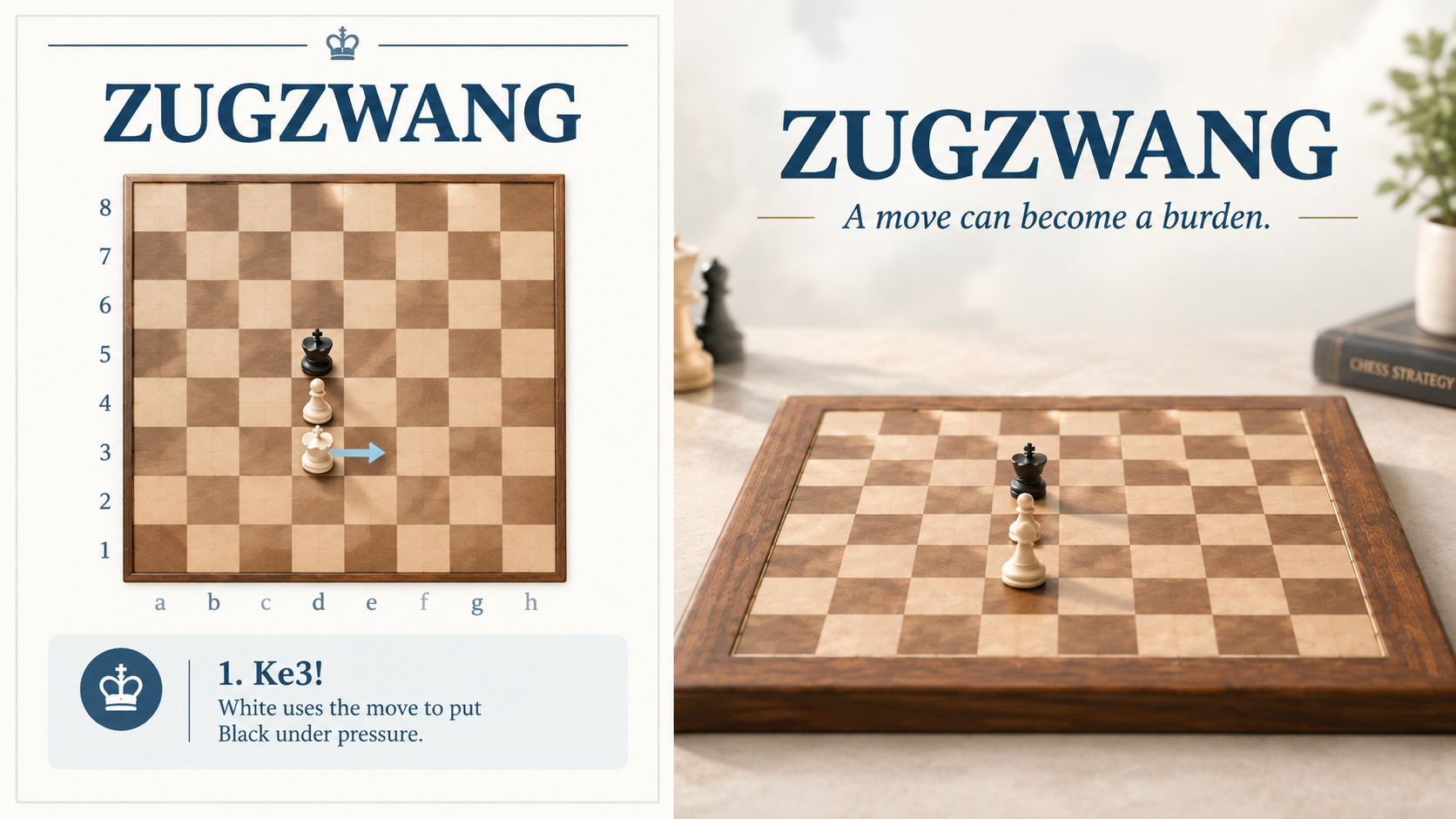
What is a zugzwang in chess? Zugzwang is a German word — roughly “compulsion to move” — describing one of the strangest situations in chess: a position where having the move is actually a disadvantage, because you’d genuinely be better off doing nothing at all.
Zugzwang Doesn’t Mean You Have No Good Moves It’s not that every available move loses outright. The core idea is that the player would be better off if they could pass their turn — but chess doesn’t allow passing, so they have to change something, and that change is exactly what creates the disadvantage.
Being Forced to Move Is the Problem Imagine an endgame where your pieces are perfectly placed, but making literally any move would weaken your position. If you could simply say “I pass,” you’d hold everything under control. But because you have to move, your opponent benefits from whatever changes. That’s zugzwang.
A Simple Example Picture two kings and a handful of pawns in an endgame, where your opponent has arranged things so that any move you make gives them an advantage. You might have several legal moves available — moving a pawn may let the opponent’s king enter, moving your own king may give up an important square, moving another piece may release control of a key area. You aren’t stuck because you have no legal moves. You’re stuck because every single one makes your position worse.
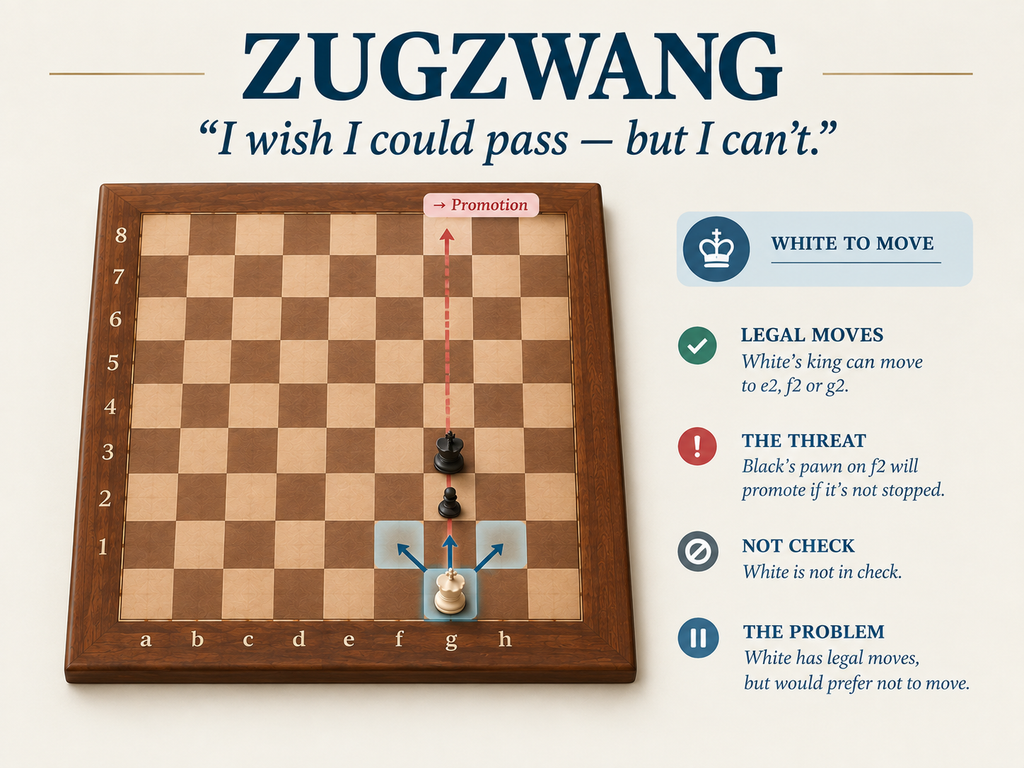
Why Zugzwang Is Especially Common in Endgames Fewer pieces on the board means a single king or pawn move can dramatically change the entire position, which is exactly why zugzwang shows up so often in king-and-pawn endgames specifically. Players sometimes spend several moves improving their position while waiting for the opponent to be the one forced to move first.
Can You Create a Zugzwang? Yes. Strong players often deliberately try to place their opponent in a position where every available move creates a weakness. A common technique is the waiting move — a move that doesn’t give up anything meaningful, but shifts the responsibility of making the next real decision back onto the opponent. If they run out of useful moves, they can end up forced into zugzwang themselves.
Zugzwang vs. Checkmate These are genuinely different situations. In checkmate, the king is in check and there’s no legal way to escape at all. In zugzwang, the player usually has legal moves available — making one of them is just harmful.
| Situation | What Happens? |
|---|---|
| Checkmate | No legal move can save the king |
| Zugzwang | Legal moves exist, but being forced to move is harmful |
The Easy Way to Remember Zugzwang Think: “I wish I could pass, but I can’t.” That’s the heart of it. The position can look perfectly playable right up until the player is actually forced to move — and sometimes the obligation to move is the entire problem.
Zugzwang is a situation where having to move can make your position worse, and it’s especially common in endgames, where a single king or pawn move can change everything. So when studying an endgame, don’t just ask “what should I play?” — also ask “would my position be better if I didn’t have to move?” That question is often exactly what reveals a zugzwang.
FIDE doesn’t define zugzwang as a formal rule of its own. But the concept exists directly within the requirement that players move alternately: Article 1.3 states that White moves first, followed by Black, with play continuing in strict alternation. That compulsory turn-taking — no option to pass — is what makes zugzwang possible in the first place. Source: FIDE Laws of Chess.
Leave a Reply