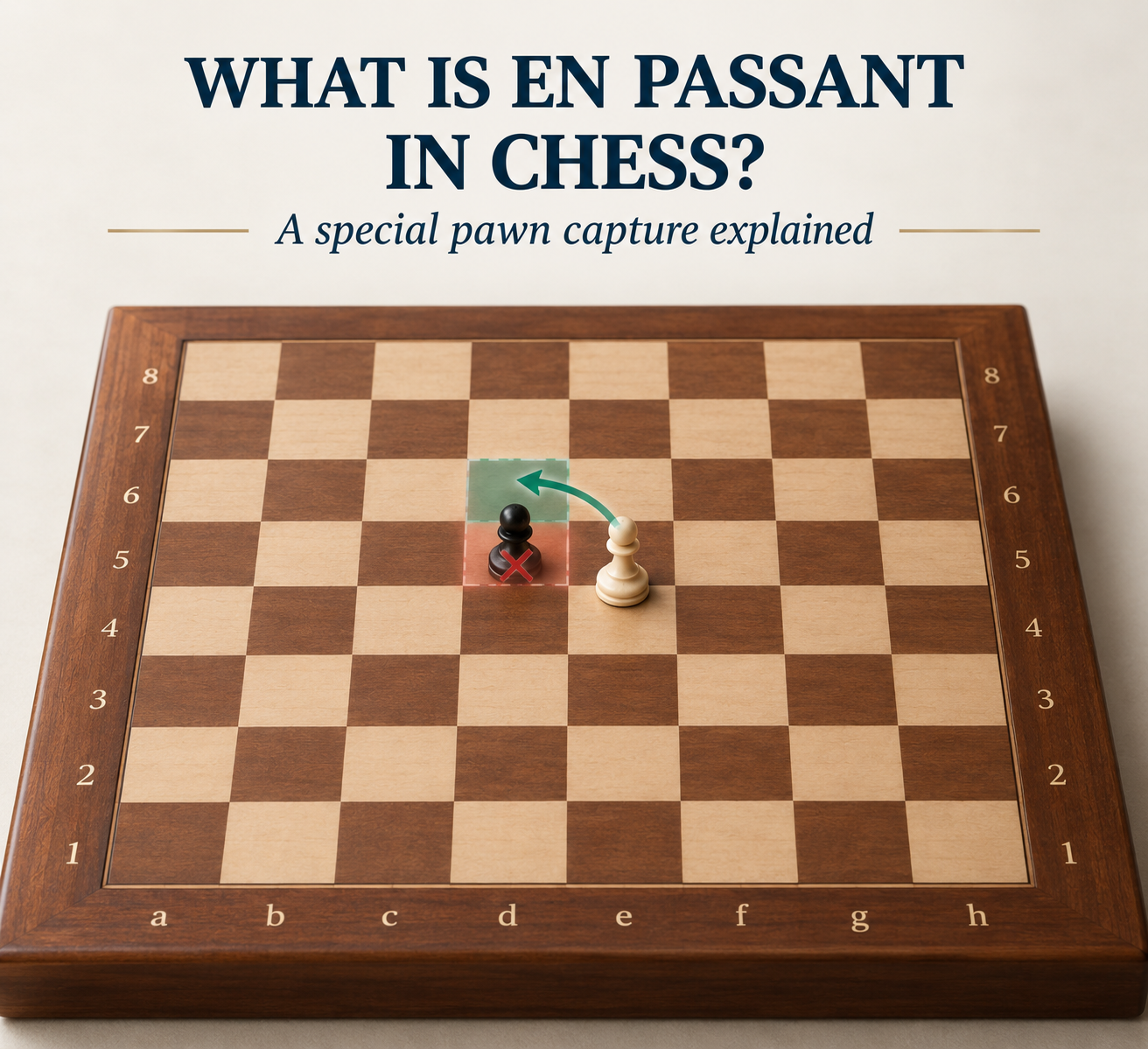
What is en passant in chess?
Without this rule, a pawn could dodge capture in a way that feels like it’s exploiting a loophole: advance two squares in a single move, and slide right past an enemy pawn that would otherwise have captured it if it had only moved one square at a time. En passant closes that gap — for exactly one move, the nearby pawn gets to capture as though the two-square advance had only been a one-square move.
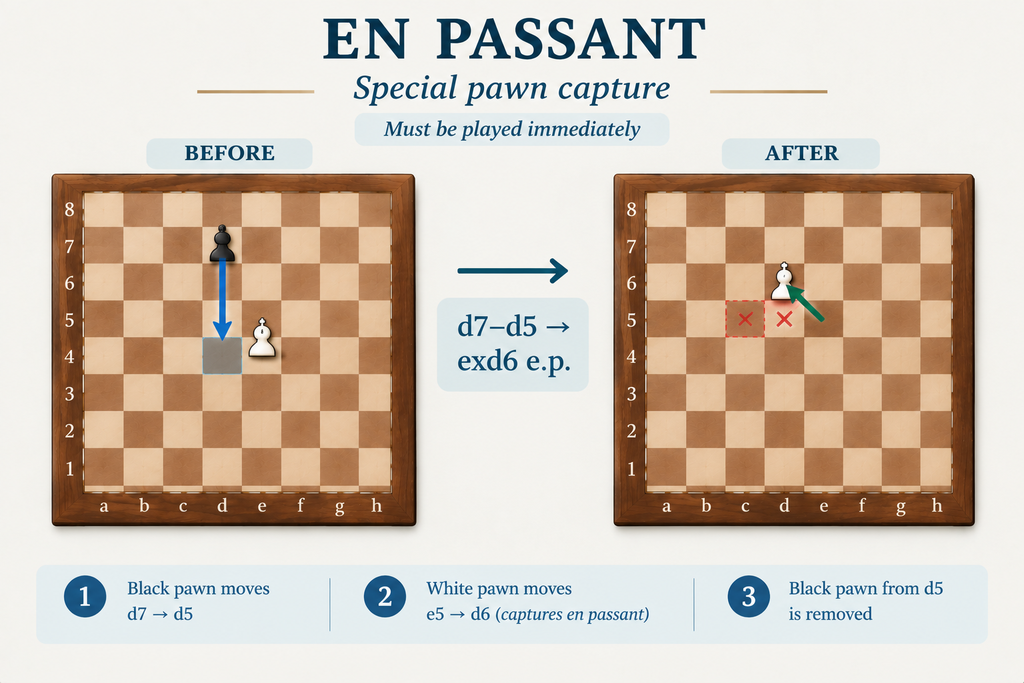
Imagine This Position Suppose White has a pawn on e5, and Black has a pawn on d7. It’s Black’s turn, and Black pushes the pawn two squares: d7 → d5, landing right beside White’s pawn on e5. On White’s very next move, White can play exd6 e.p. — the white pawn moves from e5 to d6, and the black pawn that just advanced to d5 is removed from the board entirely. Notice the capturing pawn doesn’t land on the square the captured pawn occupies, which is exactly what makes en passant look unusual the first time you see it.
Why Is This Capture Allowed? Normally, a pawn on e5 can’t capture a pawn on d5 by moving diagonally to d6 — that’s simply not how a normal capture works. But the en passant rule creates a specific exception: because the black pawn just moved two squares and passed through d6 in the process, FIDE allows White to capture it as though it had moved only one square. White captures on d6, and the black pawn that landed on d5 is what’s actually removed.
The Timing Is Critical This is one of the most important parts of the whole rule: the opportunity exists only on the move immediately after the two-square advance. If White plays anything else instead, the en passant opportunity is gone for good — White can’t wait several moves and then decide to capture the pawn en passant later.
What Conditions Must Be Met? Four things have to line up. First, the capturing pawn has to already be on the right rank and file — the fifth rank for White, the fourth for Black — directly next to the opponent’s pawn. Second, the opponent’s pawn has to have advanced two squares in a single move from its original starting square. Third, the two pawns have to end up directly side by side after that move. Fourth, and most important, the capture has to be made immediately, on the very next move — wait even one turn and the option disappears.
En Passant Is Still a Capture Even though the capturing pawn lands on a different square than the one the captured pawn occupies, en passant is still a genuine capture — the opponent’s pawn is removed from the board as part of the move. In our example, White’s pawn lands on d6, but the pawn actually being captured is the one sitting on d5.
Can You Always Play En Passant When the Conditions Are Met? Not necessarily. Like every other chess move, the en passant capture still has to be legal — you can’t make the move if it would leave your own king in check. So even when the special en passant conditions are all satisfied, you still need to consider king safety before playing it.
Why Does En Passant Exist? Without this rule, a pawn could effectively avoid capture by advancing two squares past an enemy pawn that was perfectly positioned to capture it had it moved only one square. En passant closes off that particular advantage by letting the nearby pawn capture as though the two-square advance had only been a single square.
If there’s one word to hold onto here, it’s immediately — that’s the entire trick of en passant. The rule is set out specifically in FIDE Articles 3.7.3.1 and 3.7.3.2, which describe the capture itself and its strict timing respectively. Official source: FIDE Laws of Chess.
Leave a Reply