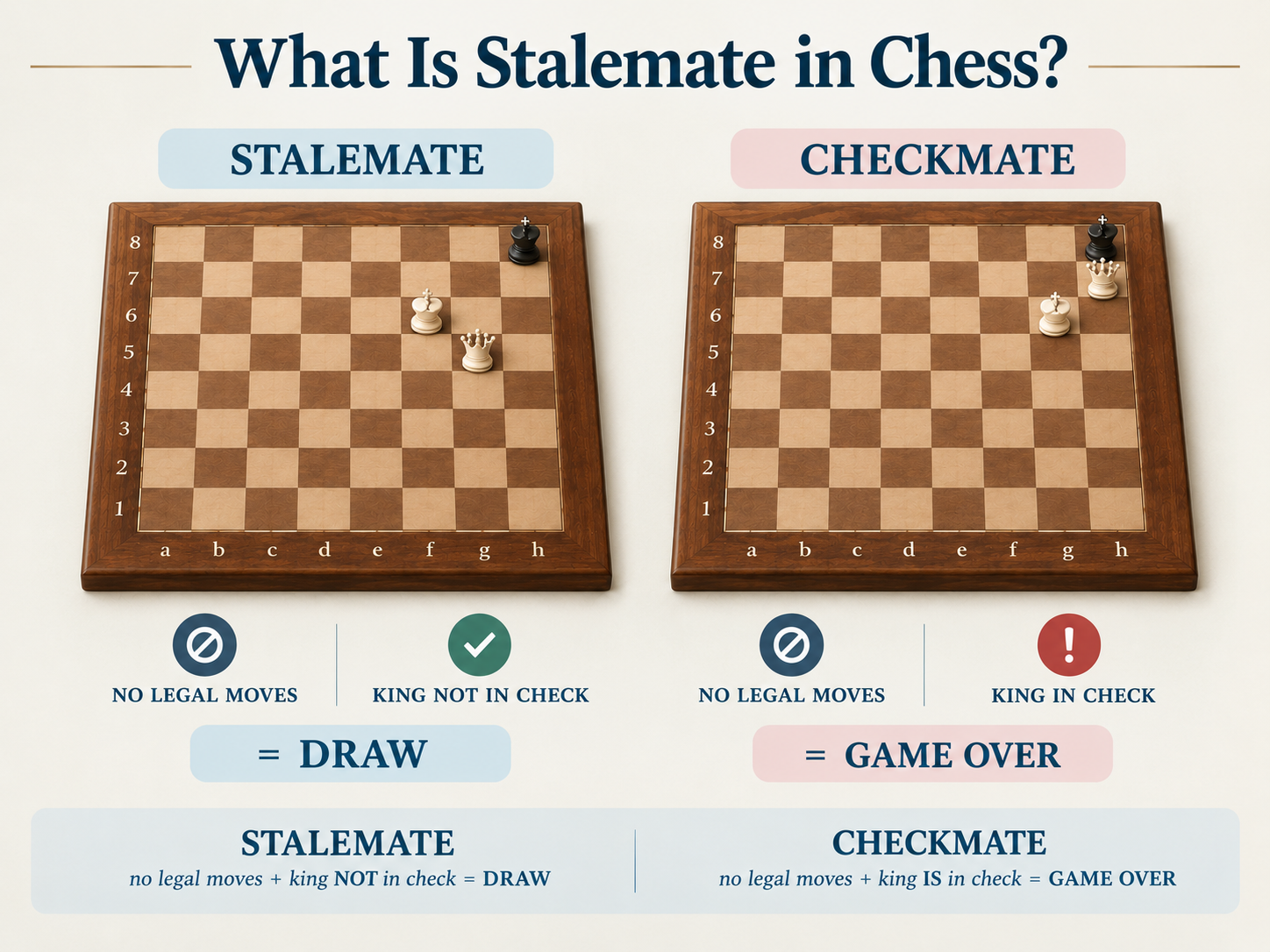
What is stalemate in chess? You’ve been completely dominating the game. Your opponent’s king has almost nowhere left to go. You play what looks like the winning move — and your opponent looks at the board and says “stalemate.” The game is a draw. It happens when the player whose turn it is has no legal move anywhere on the board, and their king isn’t in check.
Stalemate vs. Checkmate The easiest way to understand stalemate is to put it side by side with checkmate.
| Stalemate | Checkmate | |
|---|---|---|
| King in check? | No | Yes |
| Player has a legal move? | No | No |
| Result | Draw | Loss for the checkmated player |
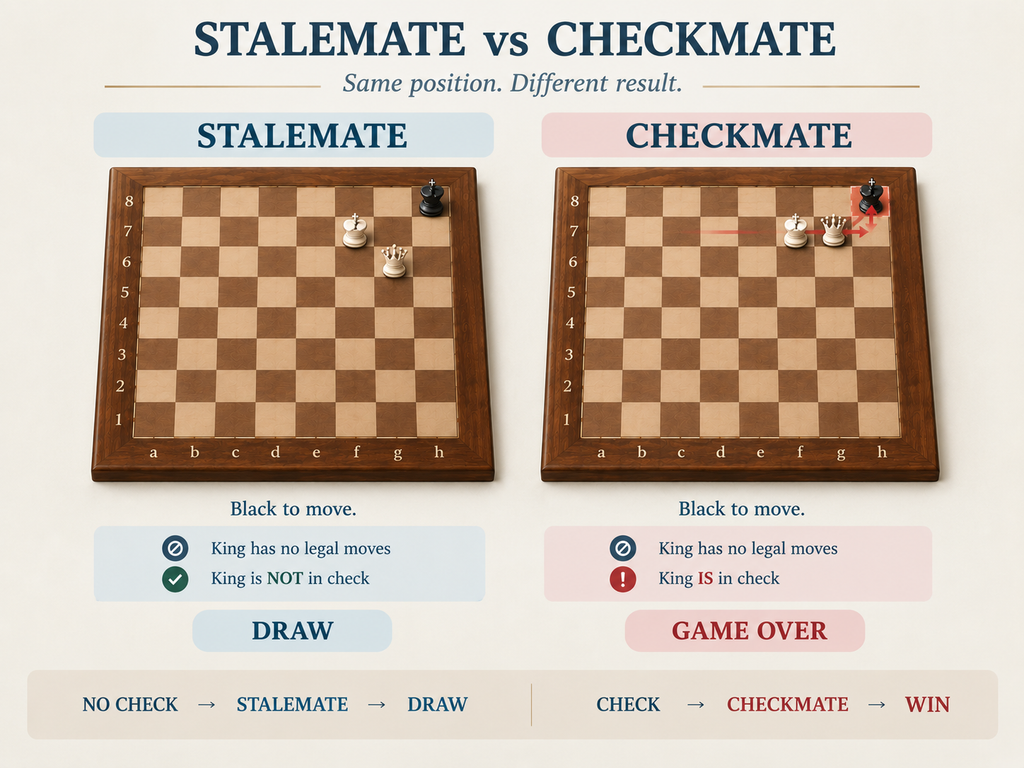
Both positions share one thing: the player has no legal move. The crucial difference is whether the king is in check. If yes, checkmate. If no, stalemate.
How Does Stalemate Happen? It usually occurs when one player’s king has been squeezed down to very few available squares, and the opponent then makes a move that removes the king’s last legal move without actually checking it. Now it’s the restricted player’s turn — no legal king move, no legal move with any other piece, and the king isn’t in check. That’s stalemate.
A Simple Example Imagine Black’s king is trapped in a corner, and White’s pieces control the surrounding squares — but none of them actually attacks the square the king itself is standing on. If it becomes Black’s turn and Black has no legal move with the king or any other piece, the position is stalemate and the game is drawn. Notice the king doesn’t need to be surrounded by pieces; what matters is whether Black has any legal move at all.
The King Does Not Have to Be Completely Trapped This is an important point that’s easy to miss: stalemate isn’t just about whether the king can move. You have to consider every piece the player has. If the king has no square to go to but the player still has a legal pawn or rook move somewhere else on the board, that’s not stalemate — a legal move still exists, so the game continues.
The Most Common Mistake Many beginners assume “if the king can’t move, it’s stalemate.” Not necessarily — the king might have no legal move while another piece can still move perfectly well, in which case the game simply continues with that other move.
The Two-Step Stalemate Test Ask first: does the player have any legal move at all? If yes, it isn’t stalemate. If no, ask second: is the king in check? If yes, checkmate. If no, stalemate. That’s the entire distinction, in two steps.
Why Stalemate Matters When You’re Winning Stalemate can be a genuinely painful way to throw away a winning position. Imagine overwhelming material against a lone king — you restrict that king until it has nowhere to go, then make one careless move that leaves it with no legal move without actually giving check. The game is immediately drawn. So when you’re winning, don’t only ask “can I checkmate here?” — also ask “will my next move accidentally create stalemate instead?”
Stalemate Is Not Checkmate This distinction is worth repeating because it matters so much: checkmate is king-in-check-plus-no-legal-move, resulting in a loss. Stalemate is king-not-in-check-plus-no-legal-move, resulting in a draw. Changing just that one condition changes the entire result.
FIDE Article 5.2.1 states that the game is drawn when the player to move has no legal move and their king is not in check — the Laws call this stalemate, and the game ends immediately once the position is produced legally. For comparison, Article 5.1.1 states that checkmate wins the game. Official FIDE source: FIDE Laws of Chess.
Leave a Reply